

Ultimate Guide to Flow States for Founders
Mar 12th 2026
Flow state isn’t just a buzzword - it’s how you turn chaos into clarity and perform at your absolute best. It’s that zone where time disappears, tasks feel effortless, and your brain fires on all cylinders. For founders juggling endless demands, this isn’t optional - it’s how you stay in the game without burning out.
Here’s the deal: Flow supercharges your brain. It silences your inner critic, speeds up problem-solving by 530%, and boosts productivity by up to 500%. But it doesn’t just happen - you have to set the stage.
Key Takeaways:
- What is Flow? A focused mental zone where action feels automatic, creativity spikes, and time warps.
- How to Trigger Flow:
- Find tasks just 4% harder than your current skill level.
- Block 90-minute focus sessions - no distractions.
- Use pre-work rituals like breathwork or movement to prime your brain.
- Why It Matters: Founders like Michael Seibel (Y Combinator) swear by flow to handle high-stakes decisions without losing their edge.
Want to go deeper? Learn how to build daily routines, use natural nootropics like Kava and Lion’s Mane, and track your flow to keep leveling up. The science is clear: Flow isn’t just a productivity tool - it’s survival for founders.
The Science and Principles of Flow States
What is Flow State?
Flow is a state of deep mental engagement where your mind locks into full immersion. In this mode, actions feel automatic, time seems to warp, and self-doubt fades away. As Mihaly Csikszentmihalyi, a leading expert on the topic, put it, "action and awareness merge."
This state isn't just a mental shift - it’s rooted in brain activity. During flow, the prefrontal cortex, which handles self-monitoring and critical thinking, temporarily powers down (a process called hypofrontality). This allows your subconscious to process information at blazing speeds - around 10 million bits per second, compared to just 40 bits per second in conscious thought. The result? Faster problem-solving, sharper pattern recognition, and creative breakthroughs that seem to come out of nowhere.
The Neuroscience of Flow
Flow is driven by chemistry, not magic. When you enter this state, your brain releases a potent mix of neurochemicals that supercharge your cognitive abilities. Here’s the lineup:
| Neurochemical | Effect During Flow |
|---|---|
| Dopamine | Boosts pattern recognition and creative problem-solving |
| Norepinephrine | Sharpens focus, attention, and heart rate |
| Endorphins | Acts as a natural painkiller and creates euphoria |
| Anandamide | Enhances lateral thinking and creativity |
| Serotonin | Promotes calm and post-flow satisfaction |
These chemical changes don’t just enhance your brainpower - they give you the edge to tackle high-pressure situations with clarity and resilience.
But reaching flow takes time. It requires about 23 minutes of uninterrupted focus to build up the necessary neurochemical levels. Distractions, like checking emails or Slack, can derail this process, costing you an extra 20–40 minutes to regain focus. This is part of the reason why nearly half (47%) of our waking hours are lost to mind-wandering.
Hitting flow also hinges on the "4% Rule": the sweet spot where tasks are 4% harder than your current skill level. If the challenge is too easy, you’ll get bored; if it’s too hard, anxiety takes over. This balance triggers the release of dopamine and norepinephrine, pulling you into flow. For instance, Stanford’s BJ Fogg structures his day into three focused 90-minute blocks (at 6:00 AM, 9:00 AM, and 2:00 PM), syncing his work with his peak performance windows.
Why Founders Need Flow
For founders, flow isn’t just a productivity hack - it’s a survival tool. With endless decisions, investor meetings, and team challenges, being in flow can mean the difference between thriving and burning out. As Michael Seibel, Managing Director at Y Combinator, notes:
"It's crucial that people working startups 'become their most formidable selves'... Practicing flow state is one way of doing so that brings compounding advantages over time."
The benefits of flow are practical and measurable. In 2023, Google software architect Sarah Chen doubled her productive coding hours - from 14 to 31 per week - by using flow triggers like clear 90-minute objectives and a 5-minute breathwork routine before diving into deep work. It’s not about working longer; it’s about working smarter, tapping into the brain’s natural ability to perform at its peak.
"Flow is more than doing in a few hours what might've taken a day. Flow is a way of unleashing your full creative potential, which you'll need to build anything new." - Jase, Founder
sbb-itb-02d64da
How To Experience Flow State Like a Pro | Steven Kotler Insight
How to Achieve Flow States as a Founder
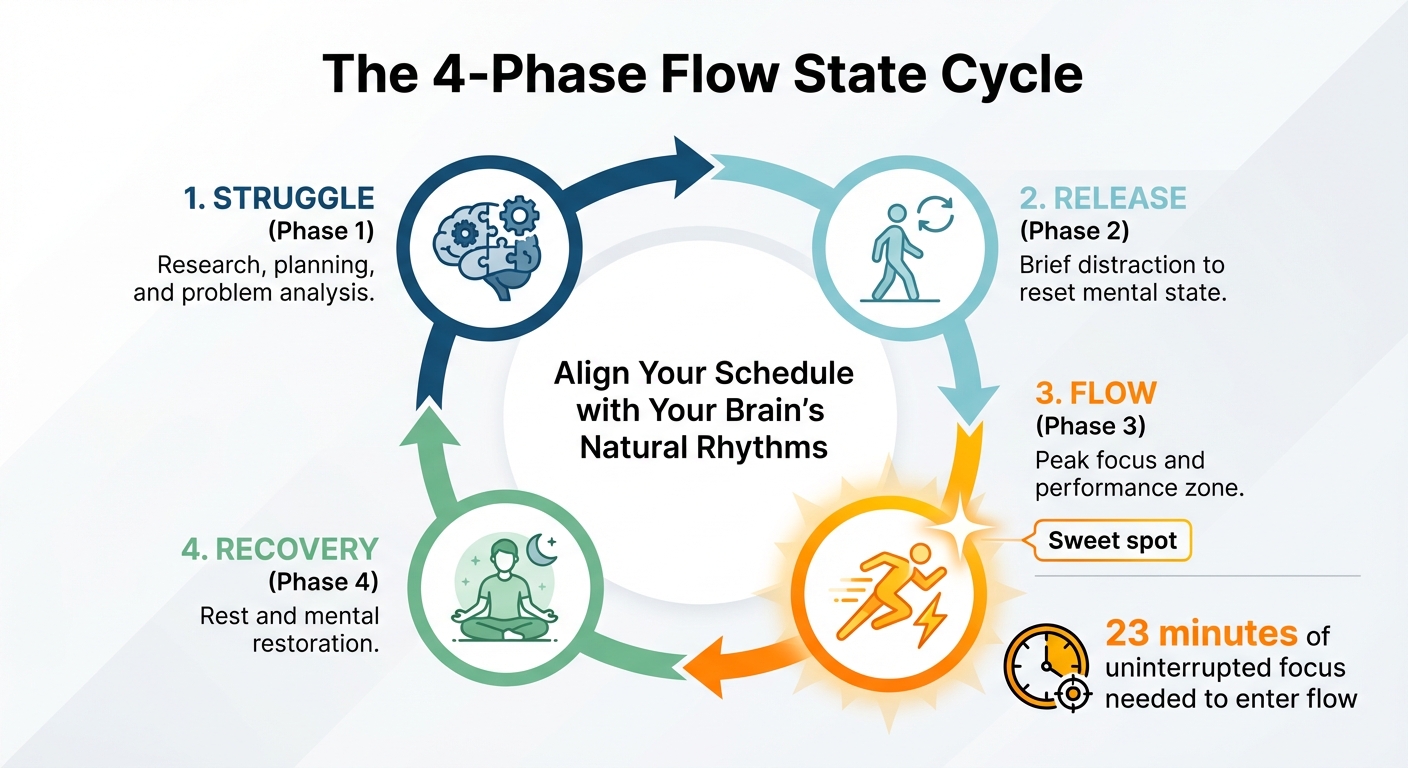
The 4-Phase Flow State Cycle for Founders
Flow doesn’t just happen - it’s something you can actively set up. The process unfolds in a four-phase cycle: Struggle (where you tackle research or planning), Release (a brief distraction to reset), Flow (the sweet spot of focus), and Recovery (resting after the mental grind). By understanding this cycle, you can align your schedule with your brain’s natural rhythms instead of working against them.
Start by creating triggers for flow. Your brain can link specific environments, sounds, or routines to deep focus. Pick a workspace - whether it’s a quiet office nook or a buzzing coffee shop - and keep it consistent. Some people swear by noise-canceling headphones and a go-to playlist, while others prefer absolute silence.
The 4% Rule is your compass for choosing tasks. Aim for challenges that are just slightly beyond your current skill level - about 4% harder - to reliably enter flow. For instance, if you’re refining a pitch deck you’ve done a dozen times, flow might not kick in. But tackling a new, slightly tougher task? That’s where the magic happens.
To hit flow, you need at least 23 minutes of uninterrupted focus. Turn off notifications, silence your phone, and carve out distraction-free blocks on your calendar. Interruptions can completely derail your focus, so guard this time fiercely.
Consider flipping your morning routine. Dive straight into your hardest tasks right after waking up - before emails, meetings, or decision fatigue start chipping away at your mental energy. Your brain is sharpest in the morning, making it the perfect time for deep work.
These habits don’t just help you tap into flow - they build a structure that supports peak performance day after day.
Daily Routines and Habits for Consistent Flow
Flow doesn’t just happen - it’s the result of intentional habits. The most effective founders design their days to make deep focus a natural state. Let’s break down how to build a routine that keeps you in the zone.
Morning Routines That Kickstart Focus
Mornings are prime time for mental clarity. Your willpower is at its peak, distractions are minimal, and your brain is ready to tackle complex problems. Protect this time by steering clear of reactive tasks like emails or social media.
One approach is the "inverted morning routine," where you dive straight into a deep work session before doing anything else. Post-sleep, your brain is in a theta wave state, ideal for creative and problem-solving tasks. Shopify CEO Tobi Lutke keeps his mornings simple: coffee, reviewing priorities, and starting work immediately - no overcomplicated rituals.
Before starting, use a pre-flow ritual to signal your brain it’s time to focus. This could mean drinking a glass of water (even mild dehydration can raise cortisol and make focus harder), stepping outside for sunlight to sync your body clock, or doing a 60-second breathing exercise like the physiological sigh - two quick inhales through the nose followed by a slow exhale through the mouth - to calm your stress response.
Identify your top one to three tasks for the day and tackle at least one before checking notifications. Avoid email and Slack for at least 60–90 minutes. As Arianna Huffington of Thrive Global says:
"The first input your brain receives sets the emotional tone for hours. Making that input intentional rather than reactive is one of the highest-ROI moves a founder can make."
For unpredictable days, create a stripped-down 8-minute routine: 2 minutes reviewing priorities, 5 minutes of light movement, and 1 minute of hydration. The best routine is the one you can stick to, even when life gets chaotic.
Once your morning sets the tone, it’s time to lock in focus during work sessions.
Time Blocking for Deep Work
Distractions kill focus. After an interruption, it takes 20–25 minutes to fully refocus due to "attention residue." Combat this by scheduling 90-minute focus blocks that align with your body’s natural energy cycles, known as ultradian rhythms. Block this time on your calendar and treat it as sacred - no meetings, no multitasking, no notifications.
Your energy peaks vary based on your chronotype. Not everyone thrives at dawn. Track your energy levels for two weeks to find your natural productivity windows, then schedule demanding tasks during those times. For example, night owls might block 10:30 AM–1:00 PM for deep work and save lighter tasks for earlier hours.
| Block Type | Best Timing | Primary Activities |
|---|---|---|
| Creative Block | Morning (first 2–4 hours) | Strategic thinking, deep writing, architecture |
| Analytical Block | Mid-day (10 AM – 2 PM) | Debugging, code review, detailed editing |
| Recovery Block | Post-lunch | Shallow work, admin tasks, meetings |
| Integration Block | Evening | Review, planning, light learning |
Batch repetitive tasks like calls or emails to specific times or days to avoid constant context switching, which can slash productivity by up to 40%.
For focus, create a distraction-free zone. Google software architect Sarah Chen doubled her weekly productive coding hours - from 14 to 31 - by setting clear 90-minute goals and using a 5-minute breathwork routine to transition into deep focus. If you’re struggling to get started, try micro-commitments: promise yourself just five minutes of work. This taps into the brain’s dopamine system and the Zeigarnik effect, which pushes us to finish unfinished tasks.
Deep work is only half the equation - recovery is just as critical.
Recovery and Rest for Long-Term Success
Flow isn’t sustainable without recovery. Skipping rest leads to burnout and reduces your capacity for deep work over time. Recovery restores the mental energy that focus sessions drain.
Not all breaks are equal. Scrolling social media or binge-watching TV may feel relaxing, but they don’t replenish your brain. Instead, opt for low-dopamine activities like walking, light exercise, or contrast therapy (switching between hot and cold exposure) to reset without overstimulating your dopamine system.
Set clear boundaries, like "shutdown hours", where your laptop stays closed. This prevents mental strain from creeping into all hours of your day. As Rey Lambie, founder of Founder Athlete, puts it:
"Stress is a performance trigger. Strain is a performance tax. Chronic, unmanaged mental strain is the highest tax a founder can pay."
End your week with a "game tape" review: reflect on what worked, what didn’t, and how you can improve for next week. With 72% of founders reporting that entrepreneurship harms their mental health and 93% showing signs of strain, recovery isn’t optional - it’s essential for staying in the game.
Using Natural Nootropics to Support Flow States
Natural nootropics can help sustain flow states throughout the day, providing a brain-friendly edge without the jitters or crashes of synthetic stimulants. These botanical compounds are especially useful during high-pressure decision-making and deep focus tasks.
Key Ingredients for Cognitive Support
Not all nootropics are created equal. The best ones work to reduce stress, maintain energy, sharpen focus, and boost memory - without overwhelming your system.
- Kava: Extracted from the Piper methysticum plant, Kava promotes calm focus by easing stress and anxiety. This helps clear mental clutter, making it easier to achieve flow states.
- Whole Leaf Kratom: Derived from Mitragyna speciosa, this ingredient provides steady energy and motivation. At lower doses, it enhances focus and drive without the typical crash. The nano-enhancement process improves absorption, delivering effects that last 4 to 6 hours, and sometimes up to 8 hours.
- Lion's Mane Mushroom: Known for supporting Nerve Growth Factor (NGF) production, this medicinal mushroom aids in memory and strategic thinking by promoting nerve cell health.
- L-Theanine: Found in green tea, L-Theanine fosters a state of calm clarity. It reduces stress while promoting relaxation, creating the ideal balance for relaxed alertness.
These ingredients work together to reduce stress and fatigue while enhancing cognitive performance, creating the perfect foundation for sustained flow.
How Founders Fuel Supports Flow
Founders Fuel is a liquid botanical supplement designed for mental clarity, focus, and long-lasting energy. Tailored to meet the demands of fast-paced environments, it blends Kava, nano-enhanced Kratom, Lion's Mane Mushroom (500mg), and L-Theanine into one formula.
The nano-enhancement process boosts Kratom's bioavailability, ensuring faster absorption and longer-lasting effects. Meanwhile, the full-spectrum Kava powder provides a smooth, balanced release that reduces stress without clouding judgment.
Manufactured in a GMP-certified facility, Founders Fuel undergoes rigorous multi-stage filtration (down to 1 micron) to ensure purity. Users report improved focus and productivity, with a 4 out of 5-star rating based on customer reviews. For best results, start with half a bottle (1 oz) between 9:00 AM and 2:00 PM, cycling 3–5 days on and 2–3 days off.
Subscription vs. One-Time Purchase
Founders Fuel offers two purchasing options to suit your needs:
| Feature | Founders Circle Subscription | One-Time Purchase |
|---|---|---|
| Price | $229/month | $279 |
| Servings | 24 servings (12 bottles) | 24 servings (12 bottles) |
| Cost per Serving | ~$9.54 | ~$11.62 |
| Savings | $50/month | N/A |
| Best For | Consistent use and long-term performance | Occasional or trial use |
| Shipping | Free | Free |
The Founders Circle subscription saves $50 per month (an 18% discount) and ensures a steady supply for peak performance. For more flexible access, the one-time purchase option is ideal for occasional use.
Measuring and Improving Flow Over Time
Flow is a skill you can sharpen over time, but it’s tricky to measure since it’s such a personal, subjective experience. Most people rely on self-recording to track it, though newer tools like EEG headbands and Heart Rate Variability (HRV) monitors are starting to offer more objective ways to measure changes in the autonomic nervous system.
Tracking Your Focus and Productivity
The most reliable way to track flow is through the Experience Sampling Method (ESM). This involves logging your mental state in real time rather than relying on memory at the end of the day - because, let’s face it, recall bias tends to distort both the highs and lows. A simple way to do this is by creating a Google Form or using an app like Reporter to rate your flow, energy, mood, and motivation on a 1–5 scale several times a day. Tools like RescueTime can even automate reminders to fill out these surveys after every two hours of computer use.
Key metrics to track include:
- Immersion: How deeply "in the zone" you felt.
- Challenge–Skill Balance: Was the task about 4% harder than your current skill level?
- Task Completion: Did you finish what you planned?
These data points can help you identify what’s working and where you need to adjust.
Refining Your Flow Strategies
Small changes to your routine can make a huge difference in your ability to enter and sustain flow. Take Sarah Chen, a software architect at Google, for example. In 2023, she boosted her productive coding hours from 14 to 31 per week by implementing two simple strategies: setting clear 90-minute goals before each session and doing a quick 5-minute breathwork exercise to prime her focus. Her results show how targeted tweaks can pay off.
Consider trying these adjustments:
- Pre-session rituals: Spend 5–10 minutes prepping your environment - play focused music, clear your desk, or do light stretching.
- Actionable tasks: Break work into manageable steps you can dive into immediately.
- Recovery strategies: Take a walk instead of scrolling your phone during breaks.
- Ultradian rhythms: Schedule deep work during natural 90–120 minute alertness cycles, followed by 20–30 minute breaks to recharge.
If you use botanical nootropics like Founders Fuel, stick to a cycling routine - 3–5 days "on" followed by 2–3 days "off" - to maintain their benefits and avoid building up tolerance. Keep tracking how your routines, settings, and supplements impact your flow, and refine your approach based on the numbers, not assumptions. The goal? A system that evolves with you and keeps you operating at your best.
Conclusion
Flow takes the grind out of work and turns it into something extraordinary. In this state, you’re not just working harder - you’re working smarter and faster, tapping into a level of creativity and subconscious processing that conscious thought alone can’t match.
The techniques outlined here are grounded in research and designed to help you get into flow more consistently. By balancing challenges with your skills (the 4% rule), scheduling 90–120 minute focus blocks during your peak energy periods, fine-tuning your environment, and making time for recovery, you’re setting yourself up for success. As Mihaly Csikszentmihalyi once said:
"Flow is like a magnet for growth. It pulls us to higher and higher levels of being, to increasingly more complex experiences."
Every time you enter flow, you’re not just checking off tasks - you’re leveling up.
Start small. Tomorrow, carve out 90 minutes for deep, uninterrupted work before you even glance at your inbox. Maybe try a soundscape to trigger focus or banish distractions like your phone. Pay attention to what clicks, tweak your approach, and build habits that make flow second nature.
For those looking to go further, targeted tools can help you stay sharp and energized. Founders Fuel offers a liquid botanical supplement crafted for high-performers. With ingredients like Kava, Lion’s Mane Mushroom, and L-theanine, it delivers steady focus without the jittery crash of typical stimulants. The Founders Circle subscription offers 12 bottles (24 servings) for $229.00 per month - an 18% savings - or you can opt for a one-time purchase at $279.00. To keep it effective, cycle your usage: 3–5 days on, 2–3 days off.
Great work doesn’t just happen - it’s engineered. Flow is your shortcut to doing your best work effortlessly. Build the habits, set the stage, and let it happen.
FAQs
How do I know I’m in flow?
When you're in a flow state, it's like the world fades away, leaving just you and the task at hand. You're completely absorbed, time feels warped, and everything clicks into place effortlessly. Ideas seem to surface naturally, and even complex tasks feel smooth and engaging. This mental state quiets self-doubt, sparks creativity, and turns challenges into something you genuinely enjoy tackling. On a biological level, your brain ramps up dopamine and norepinephrine production, sharpening your focus and enhancing your ability to spot patterns, keeping you locked into "the zone."
What should I do if I keep getting interrupted?
To stay focused and productive, cut down on interruptions and distractions. Silence notifications for chat, email, and texts, and handle communications in designated time blocks. Define clear goals and commit to short, uninterrupted work sessions - like 15–20 minutes of deep focus. These practices can help you stay in the zone, even with potential disruptions.
Are nootropics safe for daily flow?
Nootropics, when used responsibly, can be a helpful addition to your daily routine, but their safety hinges on the substance and how it's used. Natural choices such as Lion’s Mane, L-Theanine, Kava, and Kratom are often associated with improving focus, easing stress, and fostering mental clarity. To minimize risks, start with small amounts, use them sparingly, and pay attention to how your body responds. For the best outcomes, combine nootropics with healthy lifestyle habits like proper sleep, balanced nutrition, and regular exercise.
