
Is Kratom Legal for Professionals? Founders Fuel Legal Status Explained
Jan 29th 2026
Kratom’s legal status in the U.S. is a mess. At the federal level, it’s not banned but sits in a gray zone - unscheduled under the Controlled Substances Act but flagged by the DEA as a "Drug of Concern." The FDA? They’re not fans. They’ve banned it in dietary supplements and cracked down hard on imports and unverified health claims. States make it even trickier: seven have outright bans, while others enforce strict consumer protection laws.
Here’s the deal: if you’re a professional using or selling kratom, you need to know the rules. Founders Fuel keeps it clean by sticking to whole-leaf kratom, staying under alkaloid limits, and following every regulation. They don’t ship to banned states, test every batch, and enforce a 21+ age limit. Want to stay safe and legal? Know the laws and stick to trusted sources like Founders Fuel.
Key facts:
- Federal: Not banned, but FDA prohibits it in supplements.
- State Bans: 7 states + D.C. (e.g., Alabama, Indiana, Louisiana).
- Consumer Protection Laws: 24 states with strict rules (e.g., age limits, testing).
- Founders Fuel Compliance: GMP-certified, third-party testing, no shipping to banned areas.
Stay informed. Laws change fast, and ignorance won’t save you from legal trouble.
Risks, Dependence, & Legal Status of Kratom ? #anesthesia #science #doctor #opioidcrisis
sbb-itb-02d64da
Kratom's Federal Legal Status in 2026
As of January 2026, kratom remains unscheduled under the federal Controlled Substances Act (CSA), meaning possession is not a federal offense. However, the DEA continues to classify kratom as a "Drug and Chemical of Concern", keeping a close watch on its potential for abuse and its health impacts.
Back in 2016, the DEA proposed adding kratom's key alkaloids - mitragynine and 7-hydroxymitragynine - to Schedule I. This move faced overwhelming public and legislative pushback, leading the agency to withdraw the proposal. Since then, no further attempts to schedule kratom have been made. In September 2024, the FDA funded a human abuse potential study to better assess kratom's safety, a move that could shape future regulatory decisions.
Although kratom isn’t federally banned, the FDA has declared it unsafe for use in dietary supplements. It labels kratom as an "unapproved new dietary ingredient" and an "unsafe food additive." While individuals won’t face federal charges for possession, businesses selling kratom-based supplements operate in a murky legal space and risk enforcement actions from the FDA.
The FDA enforces its stance aggressively. Under Import Alert 54-15, updated in February 2025, the agency detains kratom shipments intended for dietary supplements without requiring physical inspection. Beyond this, the FDA has seized products and issued warnings to companies making unverified health claims. For example, a $3 million product seizure occurred in April 2023, and multiple firms received warning letters in July 2025.
For professionals in the field, it’s critical to understand that federal legality doesn’t mean FDA approval or provide complete legal protection. Businesses and consumers must ensure compliance with federal regulations while also navigating state laws, as federal rules do not override state-level restrictions. Up next, we’ll examine how state regulations further shape kratom’s legal landscape.
State-Level Kratom Regulations: Bans, Restrictions, and Consumer Protection Laws
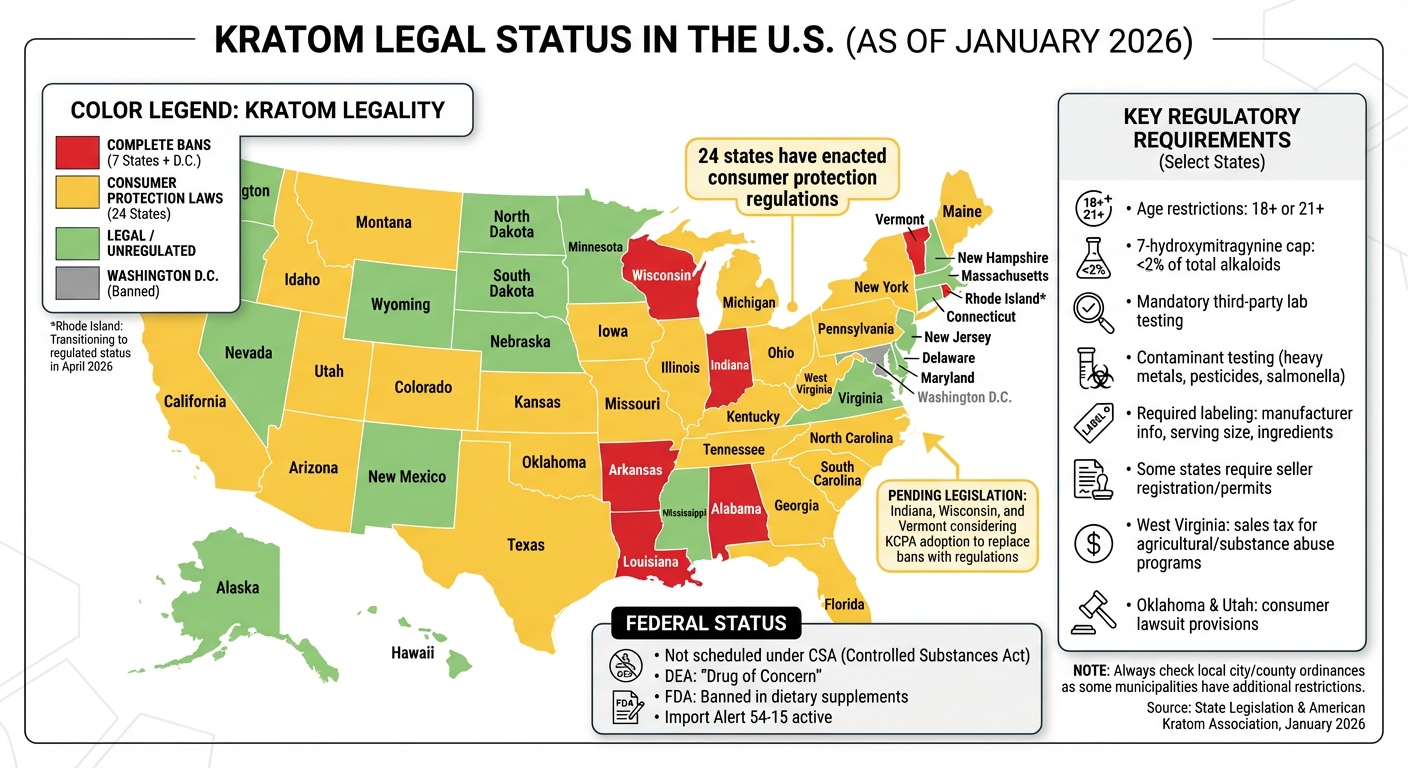
Kratom Legal Status by State 2026: Bans, Regulations, and Legal States
Kratom occupies a complex legal space in the U.S. While it's not banned at the federal level, state regulations differ widely. Some states prohibit it outright, while others enforce consumer protection measures. For professionals who often cross state lines, knowing these legal nuances is crucial to avoid potential issues. Here’s a closer look at states with bans, consumer protection laws, and those navigating pending legislation.
States That Ban Kratom
As of January 2026, seven states - Alabama, Arkansas, Indiana, Louisiana, Vermont, Wisconsin, and Rhode Island - have banned kratom entirely. Washington, D.C. also enforces a complete ban. In these areas, kratom is classified as a Schedule I controlled substance, grouping it with drugs like heroin and LSD.
Louisiana implemented its ban most recently, effective August 1, 2025. However, Rhode Island is set to reverse its prohibition, transitioning to a regulatory framework in April 2026. This marks the first instance of a state moving from a total ban to regulated use.
Possession of kratom in these states carries serious legal risks, comparable to those of other Schedule I substances. Even transporting kratom through these regions can lead to legal trouble, making it essential for professionals to exercise caution. Additionally, some cities and counties within otherwise legal states have enacted local bans, so checking both state and local laws before traveling is wise.
States with Kratom Consumer Protection Laws
As of April 2025, twenty-four states and Washington, D.C. have implemented consumer protection laws for kratom. These regulations don’t outlaw kratom but instead set strict standards for its production, labeling, and sale to ensure consumer safety.
Key provisions include mandatory age limits - either 18 or 21 - and penalties like fines or license revocation for non-compliance. Many states also cap the alkaloid 7-hydroxymitragynine at less than 2% of the total alkaloid content. This restriction targets synthetic or concentrated forms, which can be up to 13 times stronger than morphine. For instance, Tennessee bans synthetic kratom while allowing natural kratom for adults over 21.
Safety measures like testing and labeling are also mandated. States such as Utah and Oregon require third-party lab testing for contaminants like heavy metals, pesticides, and salmonella. Labels must include details like manufacturer information, serving size recommendations, and a full ingredient list. Non-compliant products risk being seized, and sellers face potential legal consequences.
Some states go further with oversight. Oregon, Utah, and West Virginia require sellers to register with state agencies or obtain permits. West Virginia also imposes a tax on kratom sales, using the revenue for agricultural and substance abuse programs. Additionally, Oklahoma and Utah allow individuals harmed by unsafe products to sue sellers.
In states without outright bans, these consumer protection laws aim to strike a balance between accessibility and safety.
States Where Kratom Is Legal and Pending Legislation
In states without bans or consumer protection laws, kratom remains unregulated. However, this doesn’t mean businesses are entirely off the hook, as federal enforcement actions are still a possibility.
Some states currently banning kratom are considering legislation to replace prohibitions with regulatory frameworks. Indiana, Wisconsin, and Vermont have introduced bills to adopt the Kratom Consumer Protection Act (KCPA), which would legalize kratom while implementing age restrictions, testing standards, and labeling requirements similar to those in other regulated states.
Mississippi presents a unique challenge. While kratom is legal statewide, failed attempts to pass bans or regulations have left a complicated patchwork of local ordinances. Professionals navigating this state must pay close attention to local laws to avoid legal pitfalls.
Regulations can change rapidly. For instance, Louisiana’s ban went into effect just months after its passage in 2025. Staying informed through legislative updates and industry news is critical for anyone using or selling kratom, ensuring compliance with evolving laws and avoiding unexpected legal issues.
How Founders Fuel Ensures Kratom Compliance
Staying compliant in the kratom industry means navigating a maze of federal and state regulations. Founders Fuel tackles this head-on by embedding strict controls into every part of its process - from manufacturing to shipping - ensuring all practices stay within legal limits.
Proprietary Blend and Manufacturing Standards
Founders Fuel’s unique formula combines whole-leaf kratom, kava, and Lion's Mane mushroom. By using natural whole-leaf kratom instead of concentrated or synthetic alkaloids, the company aligns itself with regulations aimed at preserving natural alkaloid levels.
Production happens in a GMP-certified facility, where regular audits and random testing are part of the routine. Every batch undergoes third-party lab testing to check for microbiological contaminants like Salmonella and E. coli, as well as heavy metals such as lead and arsenic. Importantly, 7-OH alkaloid levels are confirmed to stay below the 2% threshold. Certificates of Analysis from ISO 17025-accredited labs verify the purity and potency of all ingredients. This rigorous process ensures customers receive a safe, high-quality product.
Shipping and Age Restrictions
Founders Fuel strictly follows state and local laws, refusing to ship to areas where kratom is banned, such as Alabama, Arkansas, Indiana, Louisiana, Vermont, and Wisconsin.
Additionally, the company enforces a 21+ age restriction for all purchases. Age verification at checkout, which requires valid identification, ensures compliance with even the strictest state regulations - an added layer of assurance for buyers who frequently travel.
Subscription Plans for Professionals
To offer consistent supply and avoid compliance headaches, Founders Fuel provides subscription options tailored for professionals. The Founders Circle plan delivers 12 bottles (24 servings) monthly for $229, with free shipping included. A one-time purchase option is also available for $279.
These subscription plans guarantee a steady supply from a reliable, compliant source, sparing professionals the hassle of tracking regulatory updates.
Conclusion
The legal status of kratom in 2026 remains a patchwork of federal ambiguity and varying state laws. While the DEA has not classified it as a controlled substance, the FDA continues to prohibit its marketing as a dietary supplement or food additive. This creates a challenging legal environment where compliance hinges on understanding both federal guidelines and state-specific rules.
State regulations add another layer of complexity. Six states have banned kratom altogether, while 16 others have enacted consumer protection laws mandating third-party testing, age restrictions, and limits on alkaloid content. The FDA’s recent focus on concentrated 7-hydroxymitragynine (7-OH) products highlights enforcement actions targeting adulterated extracts, rather than traditional whole-leaf kratom.
Founders Fuel addresses these challenges head-on with stringent quality protocols. By prioritizing natural whole-leaf kratom with 7-OH levels below 2%, adhering to GMP-certified manufacturing standards, and conducting thorough third-party testing for contaminants, the company ensures its products meet legal and safety requirements. Additional safeguards, such as strict shipping policies and 21+ age verification, further guarantee compliance and responsible distribution.
For professionals and entrepreneurs seeking reliable performance support, it’s essential to prioritize transparency and avoid unregulated products. Founders Fuel’s subscription model not only simplifies access but also provides peace of mind, offering products that are both compliant and crafted for those striving for peak performance. This commitment to quality and safety underscores the brand’s dedication to supporting the demands of entrepreneurial excellence.
FAQs
What legal risks should professionals know about when using kratom?
The legal challenges for professionals using kratom stem from its murky regulatory landscape in the U.S. Federally, kratom isn’t classified as a controlled substance, but both the FDA and DEA have flagged concerns about its safety, potential for dependence, and lack of medical approval. This scrutiny can influence how it’s viewed in professional environments.
On top of that, kratom’s legal status shifts from state to state. Some states allow it without restrictions, while others impose bans or limitations. For professionals, this patchwork of laws creates a risk of unintentionally violating state regulations, workplace policies, or even professional licensing standards. Staying up-to-date on local laws and workplace guidelines is crucial to sidestep any legal or career-related issues.
How does Founders Fuel ensure its kratom products comply with U.S. regulations?
Founders Fuel prioritizes strict adherence to U.S. laws and regulations when it comes to its kratom products. Since kratom isn’t federally classified as a drug, dietary supplement, or food additive, the company keeps a close eye on both federal and state-level rules to steer clear of legal complications.
The company avoids making unapproved claims about kratom’s effects and ensures its marketing aligns with regulatory expectations. Founders Fuel also keeps up with legal updates, especially in areas like military or federal workplaces, where kratom use might be prohibited. This diligent approach allows the company to offer its kratom products responsibly and within legal boundaries.
Why is kratom’s legal status in the U.S. so complicated?
Kratom's legal situation in the United States is anything but straightforward. While it’s not classified as a controlled substance at the federal level, it remains under heavy regulatory scrutiny. The DEA has labeled kratom a Drug and Chemical of Concern, pointing to risks like potential dependence and harmful health effects. Similarly, the FDA has issued warnings, emphasizing that kratom isn’t approved for medical use and could pose health dangers.
On a state level, the rules are all over the map. Some states have outright banned kratom, while others allow its sale and use, creating a confusing patchwork of regulations. This fragmented approach reflects ongoing debates about kratom’s safety, possible uses, and the best way to regulate it, leaving its legal status murky in many parts of the country.
