

What Separates Good Founders from Great Ones? Mental Performance
Mar 4th 2026
Running a business isn't just about hustle - it's about how sharp your brain stays under pressure. Founders often face mental health challenges, with 93% reporting struggles like anxiety. Ignoring your brain's limits can lead to bad decisions, burnout, and business failures. Here's the deal: mental clarity and resilience aren't just personal - they're business-critical.
Key takeaways:
- Chronic stress wrecks decision-making and creativity
- Sleep deprivation (under 6.5 hours) tanks cognitive function
- Quick fixes like caffeine or stimulants only mask the problem
The fix? Natural nootropics and smarter habits.
- L-Theanine + Caffeine: Energy without jitters
- Rhodiola Rosea: Stress management
- Lion’s Mane Mushroom: Memory and focus
- Kava & Kratom: Calm under pressure
Pair these with proper sleep, nutrition, and daily routines for real results. Stop grinding yourself into the ground - think sharper, lead better, and outlast the chaos.
5 Nootropics Every Entrepreneur Should Take to Get Fired Up & Focused
sbb-itb-02d64da
Why Founders Need More Than Hard Work
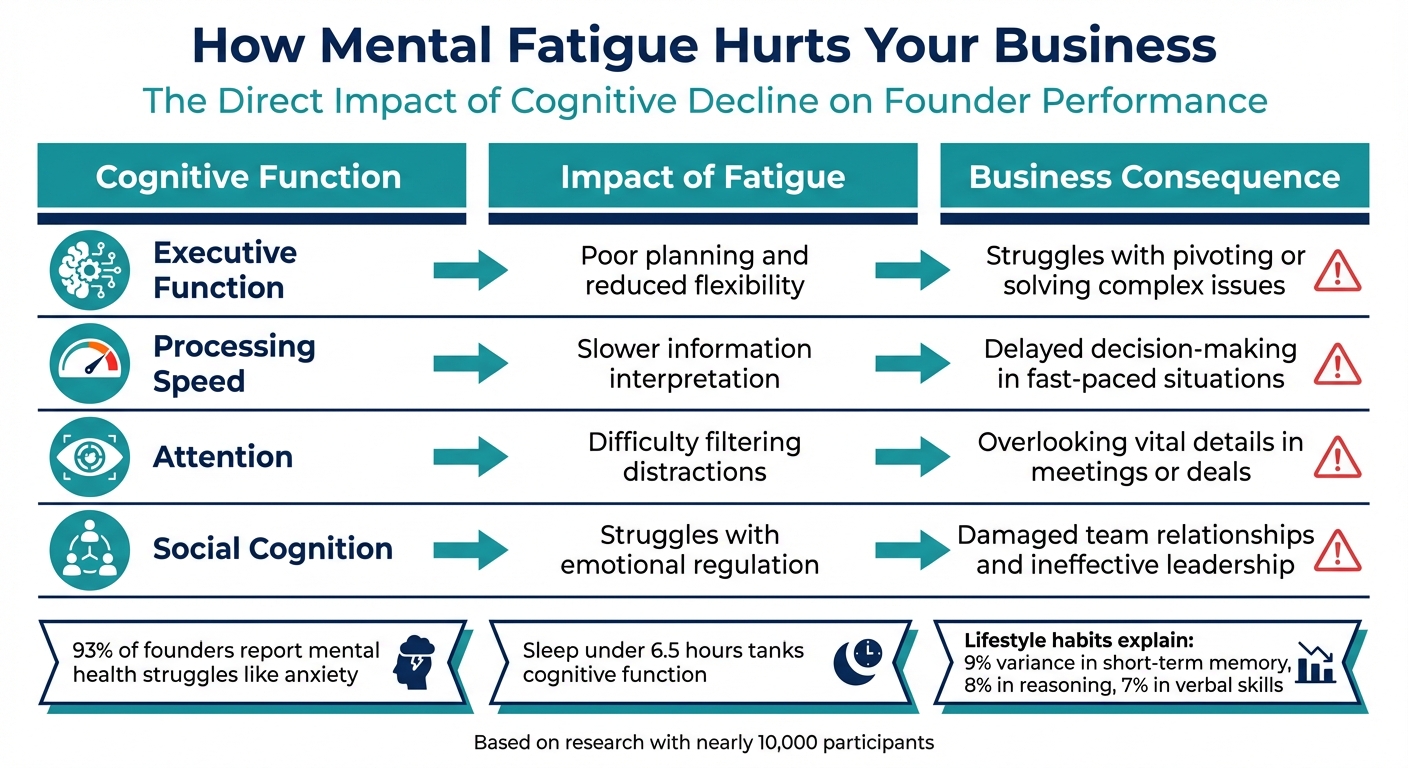
How Mental Fatigue Impacts Founder Business Performance
Hustle culture glorifies sleepless nights and relentless effort, but the toll it takes on your brain is undeniable. Chronic stress and mental fatigue push your brain into survival mode, activating the limbic system and sidelining your ability to think clearly. When you're stuck in "fight, flight, or freeze" mode, your executive functions falter, your processing speed slows, and distractions become harder to ignore.
What many founders fail to grasp is how deeply mental exhaustion can affect them. It can even lead to anosognosia - a condition where you're unaware of your own cognitive decline. This can cause you to misplace blame on your team for mistakes when the real issue lies in your impaired judgment. For CEOs, who average 62 years old, even small declines in memory and processing speed can weaken strategic thinking.
Angela Duckworth, a professor at the University of Pennsylvania, studied over 11,000 West Point cadets and found that grit - passion combined with perseverance - was a strong predictor of success in their grueling six-week training. But grit alone won't save you when your cognitive abilities are compromised. As Duckworth puts it:
"Our potential is one thing. What we do with it is quite another."
Your cognitive style - how you process, plan, and create - remains fairly consistent over time. However, chronic sleep deprivation, especially getting less than 6.5 hours of sleep, can erode your mental abilities. Yet many high performers continue to push past this threshold, ignoring the warning signs of burnout.
How Mental Exhaustion Hurts Your Business
The effects of mental fatigue go far beyond personal discomfort - they directly impact your business. Cognitive decline affects everything from strategic planning to understanding social cues during negotiations.
| Cognitive Function | Impact of Fatigue | Business Consequence |
|---|---|---|
| Executive Function | Poor planning and reduced flexibility | Struggles with pivoting or solving complex issues |
| Processing Speed | Slower information interpretation | Delayed decision-making in fast-paced situations |
| Attention | Difficulty filtering distractions | Overlooking vital details in meetings or deals |
| Social Cognition | Struggles with emotional regulation | Damaged team relationships and ineffective leadership |
This table highlights how specific cognitive impairments can lead to critical business failures. Research involving nearly 10,000 participants found that lifestyle habits - like sleep, exercise, and hobbies - accounted for measurable differences in cognitive abilities. For example, these factors explained 9% of the variance in short-term memory, 8% in reasoning, and 7% in verbal skills. In high-pressure environments, even slight cognitive lapses can mean missing a crucial detail.
The Problem with Caffeine and Prescription Stimulants
When mental energy dips, many founders turn to coffee, energy drinks, or even prescription stimulants to keep going. While these might provide a temporary jolt, they don’t address the real problem - fatigue.
Caffeine can make you feel more awake for a while, but once it wears off, you may experience a rebound effect, with slower processing speed and weaker focus. Prescription stimulants, though effective in the short term, often come with side effects like increased anxiety, disrupted sleep, and even dependency. They might sharpen focus temporarily, but they don’t solve the underlying issue and can ultimately harm your cognitive health.
Natalie Baker, founder of Neurofeedback Training Co., explains:
"Burnout happens when we push ourselves too hard, particularly our brains, which either continue functioning or begin showing signs that they need support."
The issue isn't that these substances don’t work - they do, but only as a short-term fix. By overriding your body’s signals to rest, you risk long-term cognitive damage. Studies show that adults who consistently get 7–8 hours of sleep perform far better on mental tasks than those who sleep less or more. The key isn’t masking fatigue - it’s addressing it. Up next, we’ll dive into natural nootropics that tackle these challenges at their core.
Natural Nootropics That Support Cognitive Performance
Natural nootropics can enhance mental sharpness without the energy crashes linked to synthetic stimulants. These plant-based compounds work by improving brain blood flow and offering antioxidant protection against harmful substances. The key is knowing the right nootropics to use for specific needs. Here's how these options can fill the gaps where conventional stimulants might fail.
L-Theanine and Caffeine: Energy Without the Jitters
Caffeine is a go-to for a quick energy boost, but it often comes with side effects like anxiety, jitters, and uneven focus. Pairing it with L-Theanine, an amino acid found in green tea, can smooth out these issues. L-Theanine works by inhibiting glutamate reuptake and enhancing GABA-A receptor activity, creating a calming effect that balances caffeine's stimulation. Clinical studies show that combining the two improves reaction times and focus. The result? A steady, alert energy minus the usual downsides.
For those needing to push through demanding tasks, Rhodiola Rosea offers another layer of support.
Rhodiola Rosea: Combat Stress and Fatigue
Stress tends to pile up when juggling multiple responsibilities. Rhodiola Rosea, an adaptogen, helps the body manage stress instead of just masking its symptoms. Unlike stimulants, it boosts mental endurance by reducing fatigue and promoting resilience. Research indicates that pairing Rhodiola with magnesium, B vitamins, and green tea can increase theta brain activity - linked to relaxed alertness and better focus under pressure. To see lasting benefits, a consistent four-week regimen is recommended, especially for those facing prolonged high-stress periods.
For a direct boost in memory and problem-solving abilities, Lion's Mane Mushroom stands out.
Lion's Mane Mushroom: Memory and Cognitive Support
Lion's Mane Mushroom (Hericium erinaceus) contains compounds like hericenones and erinacines that cross the blood-brain barrier and stimulate Nerve Growth Factor (NGF) production, which supports brain plasticity. A single dose of 1.8–3 g can enhance task performance within 60–90 minutes, while a 28-day regimen has shown a trend toward reduced stress levels.
Sarah Docherty, a researcher at Northumbria University, highlights its potential:
"The findings tentatively suggest that Hericium erinaceus may improve speed of performance and reduce subjective stress in healthy, young adults."
For those managing complex decisions or multitasking, Lion's Mane offers both immediate and long-term cognitive benefits.
When handling high-pressure situations, Kava and Whole Leaf Kratom can provide calm without mental sluggishness.
Kava and Whole Leaf Kratom: Stress Relief Without Clouding the Mind
Kava and Whole Leaf Kratom are effective tools for managing stress while maintaining mental clarity. These botanicals modulate the body's stress response, keeping you calm and focused during demanding tasks. Unlike prescription medications that may dull cognitive function, these options allow you to stay sharp under pressure. For best results, it's advised to first establish a routine with adaptogens like Rhodiola before introducing these botanicals for specific high-stress moments. This layered approach supports both immediate performance and long-term mental resilience.
| Nootropic | Primary Benefit | Effect Timing | Mechanism |
|---|---|---|---|
| L-Theanine + Caffeine | Focused energy, reduced anxiety | Acute (≈60 minutes) | Adenosine inhibition; GABA-A modulation |
| Lion's Mane | Enhanced performance, memory | Acute (60–90 minutes) / Chronic (stress reduction) | Promotes Nerve Growth Factor (NGF) |
| Rhodiola + Mg + B-Vits | Stress resilience, improved attention | Acute/Chronic | Increases EEG theta activity |
| Kava & Whole Leaf Kratom | Stress management, composure | Acute | Modulates stress response while maintaining clarity |
Daily Routines for Consistent Mental Performance
When and How to Take Nootropics
Timing your nootropics with your body’s natural rhythms can make all the difference. For example, take focus-enhancing compounds in the morning or early afternoon to boost productivity, and save calming supplements for the evening to help unwind and prepare for sleep.
Caffeine is a key player here. Its effects peak about 30 minutes after consumption and can enhance focus for around an hour. However, about 25% of caffeine lingers in your system even 12 hours later. As Andrew Huberman, Ph.D., from Stanford University, advises:
"To protect your sleep, it's typically best to avoid caffeine for at least 10-12 hours before bedtime."
So, if you’re aiming for a 10 p.m. bedtime, cut off caffeine intake by late morning. Another tip? Delay your first caffeine dose by 90–120 minutes after waking to avoid crashing later in the day. Pairing 100–200 mg of caffeine with an equal dose of L-theanine can smooth out jitters and help maintain focus. For even better energy stability, combine caffeine with water and electrolytes, or a pinch of sea salt. If you’ve got a big event or deadline, a short caffeine reset can make its effects more noticeable when you need them.
Evenings are all about recovery. Supplements like magnesium threonate or lion's mane, taken 1–2 hours before bed, can help you wind down and prepare for restful sleep. Sharon Duguid of Cereflex Labs highlights the importance of timing:
"Stimulants like caffeine and L-theanine are best in the morning for focus, while calming compounds like magnesium and lion's mane work well in the evening."
While nootropics can provide a quick cognitive boost, they work best when paired with strong foundational habits.
Combine Nootropics with Sleep, Nutrition, and Stress Management
Nootropics shine brightest when they’re part of a disciplined lifestyle focused on sleep, nutrition, and stress management. They’re not magic pills; they enhance what’s already there. Jason Karp, Founder of Hu Chocolate, puts it bluntly:
"90% of optimal health is easy and free. Sleep and sunlight. If you don't prioritize those elements in your routine, all the crazy biohacking gadgets are worthless."
Sleep is the cornerstone of mental performance. To improve sleep quality, keep your bedroom at 65°F (18°C), use blackout curtains or an eye mask, and consider a white noise machine to minimize disturbances (a good one costs around $50). Stick to consistent sleep and wake times - even on weekends - to avoid "social jet lag", which can throw off your REM cycles. Before bed, jotting down unfinished tasks or tomorrow’s priorities can help settle your mind by closing those mental "open loops". Chris Sparks, an Executive Performance Coach, doesn’t mince words:
"You're trading tomorrow's decision quality for tonight's minor task completion. You're borrowing against future performance at predatory interest rates."
Nutrition and exercise are just as critical. For sharper thinking, consider adding 5g of creatine or 1–2g of omega-3s to your daily routine. Structure your workday around what’s known as the "four-hour rule" - most people can only maintain deep focus for about four hours at a time. Schedule your most demanding tasks between 6 AM and 10 AM, when cognitive performance peaks, and shift to less mentally taxing work later in the day. Short micro-breaks throughout the day can combat fatigue and keep your mind sharp.
Many high-achievers swear by three "non-negotiables" - usually sleep, nutrition, and exercise - and make these priorities untouchable, even during their busiest times. When these basics are solid, nootropics and other optimization strategies become far more effective.
Conclusion
The difference between good founders and great ones isn’t about grinding harder - it’s about thinking smarter, making quicker decisions, and staying mentally sharp. When mental fatigue creeps in, decision-making suffers. Quick fixes that mask the problem only make it worse in the long run.
Natural nootropics provide a smarter approach. Pairing L-Theanine with caffeine can enhance focus, Rhodiola Rosea helps manage stress, Lion’s Mane supports memory, and Kava with Whole Leaf Kratom aids in stress relief. Together, these options promote sustainable mental clarity and energy.
To maximize results, combine nootropics with strong habits. Align them with your body’s rhythms - use focus-boosting compounds in the morning and calming ones in the evening. This consistency builds long-term mental performance.
For founders seeking an edge, optimizing mental performance isn’t optional. Research highlights that Rhodiola reduces fatigue and errors in high-pressure tasks, while Lion’s Mane improves clarity and memory retention over time. These benefits translate into sharper decisions, sustained creativity, and the resilience to outlast competitors.
Invest in targeted nootropic stacks that fit your routine and amplify your cognitive edge. Your brain is your most powerful tool - treat it like the asset it is.
FAQs
How do I know if stress is hurting my decisions?
Stress can mess with your decision-making in ways you might not even notice. If you’re finding it tough to focus, making snap judgments, or reacting emotionally instead of thinking things through, stress could be the culprit. Over time, chronic stress can lock your brain into autopilot, relying on rigid habits instead of allowing for clear, critical thinking.
What’s a safe beginner nootropic stack for founders?
For those just starting with nootropics, a beginner-friendly stack includes L-Theanine and Lion’s Mane. These supplements are often chosen for their ability to gently support focus and overall brain health. They’re affordable, low-risk, and a solid starting point for anyone curious about cognitive supplements.
How can I boost focus without wrecking my sleep?
You can boost focus while still getting quality sleep by turning to natural options like L-Theanine, Kava, Lion's Mane, and Whole Leaf Kratom. These botanicals and nootropics can help sharpen mental clarity without the sleep-interrupting effects of stimulants. Pair these with habits like hydrating first thing in the morning, soaking up some sunlight, eating a protein-rich breakfast, staying physically active, and ending your day with screen-free downtime. These approaches emphasize long-term balance over short-term solutions.
