

Founders Fuel Cost Analysis: Is $279/Month Worth It for Founders?
Jan 27th 2026
Founders Fuel costs $229–$279 per month, promising sharper focus, better energy, and reduced stress. At about $9.54 per serving, it’s a premium option compared to coffee ($50–$180/month) or most nootropic supplements ($30–$100/month). But does it justify the price?
Here’s the breakdown:
- Founders Fuel: Combines Kava, Kratom, Lion’s Mane, and L-theanine for sustained mental performance. Claims to save 8–12 hours/week, equating to $6,400–$9,600 in potential value at a $200/hour rate.
- Coffee: Cheap and effective for quick energy, but can cause jitters, crashes, and poor sleep.
- Nootropics: Targeted brain support with varying costs and results. Some require months for noticeable effects.
- Productivity Methods: Free strategies like time-blocking and better sleep often outperform supplements.
Verdict? Founders Fuel might be worth it if you’ve already optimized your sleep, schedule, and habits. Otherwise, fix the basics first - no supplement can replace a solid foundation.
1. Founders Fuel

Cost
Founders Fuel is available as a subscription for $229 per month or a one-time purchase of $279, each providing 12 bottles (24 servings), breaking down to about $9.54 per serving. By comparison, the average monthly cost of supplement stacks among over 60,000 users is $172, while some specialized powders cost as little as $7.75 per serving. What sets Founders Fuel apart is its liquid format and a proprietary blend of ingredients, including Kava, Whole Leaf Kratom, Lion's Mane Mushroom, and L-theanine. This positions it as a comprehensive cognitive formula rather than a single-ingredient supplement. Let’s dive into how it performs.
Effectiveness
Premium cognitive formulas typically enhance focus by 58%, boost alertness by 56%, and increase calmness by 6%, even counteracting caffeine’s usual 18% dip in calmness - all while maintaining mental clarity without the dreaded crash. Founders Fuel’s formula is designed to target multiple brain pathways - energy production, neurotransmitter activity, cerebral blood flow, and neuroprotection - to deliver consistent, sustained mental performance. This multi-faceted approach forms the foundation of its effectiveness.
Convenience
Each 2oz bottle is pre-measured and ready to use - no mixing powders, no juggling multiple pills, and no second-guessing dosages. This grab-and-go format protects your most productive "power windows", the times you need to be at your sharpest for deep work. Pre-made stacks like this are often safer and more reliable than DIY solutions, which can come with safety risks. This simplicity adds another layer of appeal, especially for those seeking efficiency.
Long-Term ROI
Is the $229 monthly price tag worth it? If Founders Fuel helps you reclaim 8–12 hours per week, that’s 32–48 extra productive hours a month. At a $200 hourly rate, this translates to $6,400–$9,600 in potential value. Leaders who prioritize their energy and decision-making capacity can see up to a 24% boost in overall productivity. While supplementing for cognitive health requires a long-term perspective, the payoff becomes clear when it helps preserve your mental energy during critical growth periods.
sbb-itb-02d64da
2. Coffee
Cost
When it comes to cost, coffee is a clear winner compared to pricey supplements that can run up to $400 a month. Brewing your coffee at home costs just $0.30–$1.67 per 16-ounce cup, adding up to about $50–$90 monthly. The upfront investment for decent brewing equipment ranges from $60–$100. On the other hand, if you're a café regular, expect to spend up to $180 a month on your coffee habit. These numbers set the stage for comparing coffee’s affordability to its actual impact on focus and productivity.
Effectiveness
Coffee’s low cost is appealing, but does it deliver the mental edge it’s famous for? A basic 8-ounce drip coffee packs around 95 mg of caffeine and contains antioxidants like chlorogenic acid, which are beneficial for heart and brain health. Research shows that about 100 mg of caffeine can improve mood and sharpen memory. However, more isn’t always better. Take the cautionary tale of James Beshara, a 26-year-old founder who ended up in the emergency room after downing 5–6 cups of coffee daily during grueling workweeks. His diagnosis? Atrial fibrillation caused by caffeine overload, which spiked his cortisol levels and led to anxiety and insomnia. As Beshara explained:
"You can be awake and completely alert but terribly unproductive because you're anxious".
This highlights a key downside: too much caffeine can leave you jittery and unfocused, undermining productivity rather than boosting it.
Convenience
Brewing coffee at home is quick and easy, taking about five minutes. A trip to your favorite café, however, might add 6–10 minutes to your routine. While café coffee offers the convenience of grab-and-go with no cleanup, home brewing wins on cost and comfort - perfect for those "pajama mornings". Once consumed, coffee kicks in within 30–45 minutes and keeps you energized for 3–5 hours. Timing your intake wisely can help you power through your day without crashing.
Long-Term ROI
Coffee’s value isn’t just in its immediate effects; its long-term health benefits are worth noting too. Regular consumption of 200–300 mg of caffeine daily has been associated with a 41% lower risk of type 2 diabetes and stroke. That said, tolerance can build over time, meaning you might need more to feel the same effects. The FDA advises keeping caffeine intake under 400 mg per day - roughly four 8-ounce cups - to avoid cardiovascular strain. While coffee provides antioxidants and caffeine, it lacks the extra neuro-supportive ingredients (like B-vitamins and specific amino acids) found in specialized cognitive formulas.
Balancing coffee’s affordability, effectiveness, and convenience makes it a solid option for many, but understanding its limitations is key when weighing it against other nutritional tools for high-performing individuals.
I tested if Nootropics really work with Neurable Focus-Tracking AI Headphones data

3. Nootropic Supplements
Beyond Founders Fuel and coffee, nootropic supplements offer another way to sharpen mental performance, catering specifically to the needs of founders.
Cost
The price of nootropics depends on what you’re buying - prescription medications, pre-made stacks, or individual ingredients. Prescription options like Modafinil (Provigil) can cost around $400 for a one-month supply, while Adderall is closer to $100 per month. Over-the-counter stacks are more affordable, typically falling between $30 and $100 per month. If you’re into customizing your stack, individual ingredients vary widely: L-theanine ranges from $12 to $100 depending on purity, and Aniracetam is about $30. Trying out different combinations can add up, with annual costs often landing between $500 and $1,000. But price isn’t the only factor - how well these supplements work for you depends on their interaction with your brain chemistry.
Effectiveness
Nootropics aim to boost brain energy, balance neurotransmitters, improve blood flow, regulate brain waves, protect neurons, and even encourage new brain cell growth. Since the brain uses about 20% of the body’s energy, these supplements target real physiological needs. That said, their effectiveness varies greatly depending on the ingredient and how long you take it. For example, caffeine and L-theanine deliver immediate results, while Bacopa monnieri requires 300–600 mg daily for several months to show memory improvements. One study noted reaction times improved after 30 days of use, but the $50 monthly price tag left some questioning its value. These mixed results highlight the importance of experimenting to find what fits your routine.
Convenience
Most nootropics come in pill or capsule form, making them incredibly easy to use - no brewing, no cleanup, just pop one and go. To ensure you’re getting a quality product, look for third-party testing certifications like Labdoor, NSF, or USP.
Long-Term ROI
When paired with a solid lifestyle - good sleep, morning sunlight, and stress management - nootropics can amplify your performance. However, they won’t fix underlying issues like sleep deprivation or burnout. The global nootropics market is expected to hit $11.41 billion by 2032, growing at 12.1% annually, reflecting their rising popularity. But keep in mind, most nootropics are not FDA-approved, and their long-term effects remain largely unknown. Risks like anxiety, insomnia, or addiction are worth considering. To measure their true impact, try a "washout" period - stop taking the supplement for a week after using it to see if the benefits disappear, which can help you rule out placebo effects. As Kamal Patel, co-founder of Examine, explains:
"The best bang for your buck comes from supplements with proven, substantial effects... You need to be the Sherlock Holmes of supplementation to sleuth your way through all the suspects".
Switching from an expensive supplement to a more affordable one in the same category could save you $430 to $500 annually. Choosing wisely isn’t just about results - it’s also about keeping your wallet happy in the long run.
4. Productivity Methods
Boosting productivity doesn’t always require expensive tools or supplements. Often, it’s about how you allocate your most focused hours. The problem? Many of us waste our peak energy on low-priority tasks. For instance, workers spend 58% of their time on "work about work" - think endless emails and status updates - while executives lose up to 25% of their week managing communication logistics. This mismanagement of time and energy can be tackled with smarter productivity strategies that cost nothing.
Cost
Most productivity techniques are completely free. Practices like morning light exposure, consistent sleep schedules, and blocking time for deep work demand only your attention, not your wallet. If you’re ready to invest, hiring an Executive Assistant can free up your time for high-impact work, effectively multiplying your energy. Compared to the $279 monthly cost of Founders Fuel, these methods are a no-brainer in terms of affordability. They’re the backbone of meaningful productivity gains without breaking the bank.
Effectiveness
The results can be game-changing. Just like energy-boosting supplements, an energy audit can help reclaim 8–12 hours each week by cutting out non-urgent tasks that eat up 30 minutes or more. Delegation is another powerhouse strategy - leaders who delegate see a 24% jump in productivity across their teams. Protecting your “power windows” (typically 7–11 AM for most people) for deep, strategic work instead of admin tasks can revolutionize your output.
Convenience
These strategies are ridiculously simple to apply. Start by tracking your tasks for five days to pinpoint what’s draining your energy. Then, block off your high-focus hours for meaningful work and save routine tasks for when your energy dips. Want to make it even easier? Try the “One Change” rule: test one habit at a time for 14–30 days, then take a one-week break to see if the benefits stick.
Long-Term ROI
Like premium cognitive products, these habits deliver lasting results. They tackle the core factors driving energy - sleep, light exposure, and stress management. Without these fundamentals, even the best supplements fall short. For example, setting firm work-life boundaries can slash burnout rates from 45% to just 6%. On top of that, serial founders who refine their productivity strategies see a business growth rate of 65.7%, compared to 28.4% for first-time founders. The bottom line? Structural changes to your work habits offer long-term gains that far outweigh quick fixes.
Advantages and Drawbacks
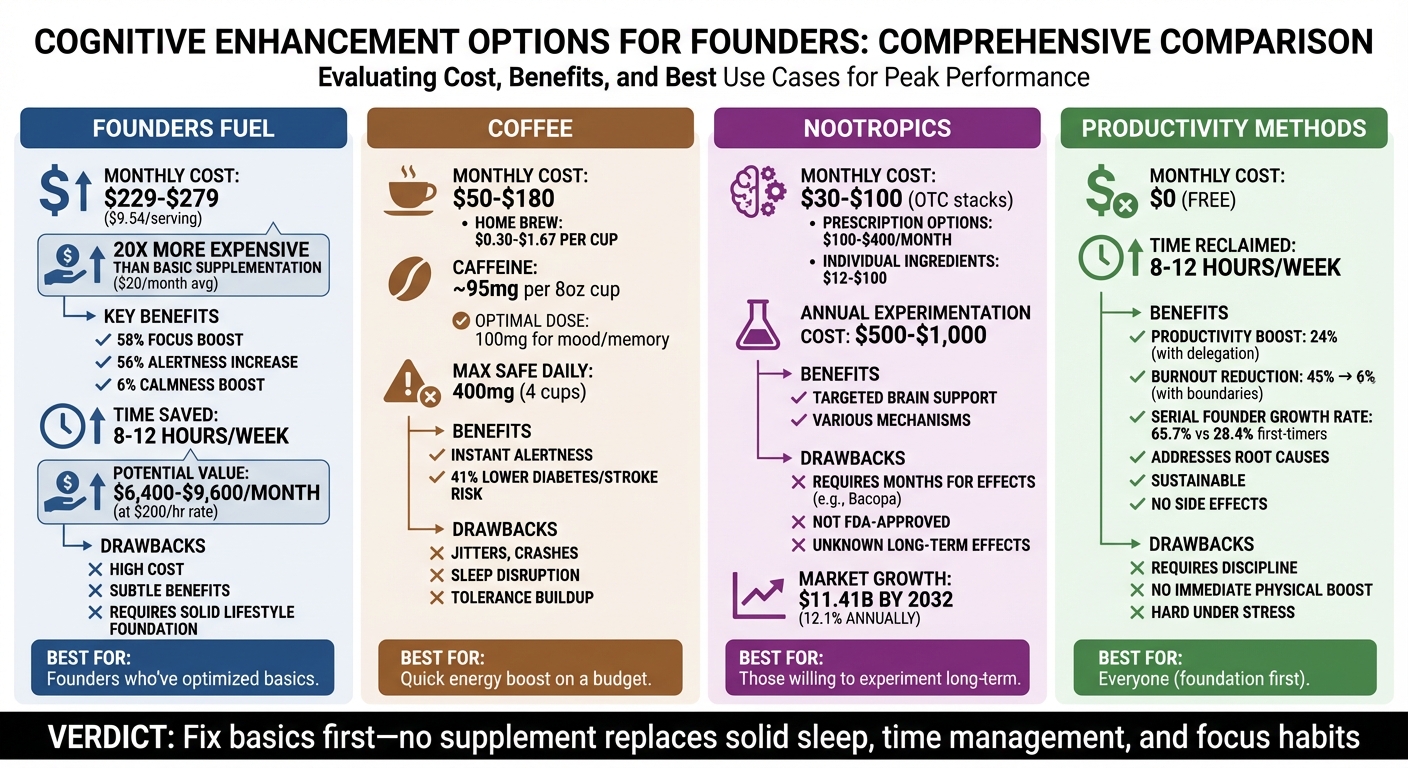
Cost-Benefit Comparison: Founders Fuel vs Coffee vs Nootropics vs Productivity Methods
This section pulls together the pros and cons of various options into a straightforward comparison.
Each choice comes with its own set of perks and limitations. Here's a quick snapshot:
| Option | Key Advantages | Key Drawbacks |
|---|---|---|
| Founders Fuel | A botanical blend aimed at energy, memory, and stress management - crafted for founders seeking "calm speed" (includes L-theanine for focus) | High cost at $279/month; benefits may feel subtle and could be overshadowed by poor lifestyle habits |
| Coffee | Instant alertness boost; cheap and widely available; effective in doses of 40–300 mg for fighting fatigue | Short-lived effects; doesn't enhance complex thinking; can cause jitters, crashes, and disrupt sleep; excessive use linked to heart strain |
| Nootropic Supplements | Targeted cognitive support with potential long-term brain health benefits; some options avoid stimulants entirely | Require consistent use over months (e.g., Bacopa monnieri); proprietary blends may skimp on effective dosages; evidence for benefits in healthy adults is often lacking |
| Productivity Methods | Tackle root issues like sleep and time management; can free up 8–12 hours weekly without spending a dime | Require strong discipline and effort; no immediate physical boost; tough to stick with under high stress |
While the table outlines the trade-offs, there's an underlying risk: relying on supplements to compensate for weak fundamentals. As Biohacking Foundations puts it, "Many people try to fix poor sleep with pills, fix low energy with stimulants, and fix a chaotic schedule with 'adaptogens.'" No supplement - no matter how pricey - can make up for bad sleep or spending hours bogged down in non-productive tasks.
Founders Fuel's blend of Kava, Kratom, Lion's Mane Mushroom, and L-theanine is tailored to the intense cognitive demands of entrepreneurs. Designed to deliver "calm speed," it promotes sharp thinking under pressure without triggering panic. Supporting cortisol regulation and dopamine synthesis, it may help founders tackle uncertainty and take calculated risks without spiraling into anxiety.
Coffee and basic nootropics provide quick, surface-level benefits, but only a founder-specific formula like Founders Fuel offers a more comprehensive, sustained approach. For example, during a 30-day trial, journalist Josh Helton from The Hustle reported his reaction time improved from 367 milliseconds to 272 milliseconds. Yet, he admitted, "If the pills were slipped in my food without me noticing each morning, I would never know they were in me." For founders making high-stakes decisions, even a slight edge can be meaningful - or it might highlight that supplements should only enhance a solid foundation, not replace it.
The takeaway? Supplements shine brightest when paired with healthy habits. Productivity methods are a no-cost but discipline-heavy alternative, and while coffee offers a quick jolt, its effects are fleeting. Founders Fuel, with its $279 price tag, positions itself as a premium option - potentially worth the investment for those already committed to strong lifestyle practices.
Conclusion
At $279 per month, Founders Fuel demands a hefty investment - more than 10 times the cost of basic supplementation, which averages $20 monthly. The real question isn't about the quality of ingredients like Kava, Lion's Mane, and L-theanine - it’s whether these components deliver enough of an edge to justify the steep price tag.
Pilot studies suggest that multi-ingredient cognitive formulas can boost focus by 58% and alertness by 56%, but results in real-world scenarios can vary. Kamal Patel, Co-founder and Director at Examine, puts it plainly:
"The best bang for your buck comes from supplements with proven, substantial effects."
For founders who’ve already nailed the essentials - like quality sleep, effective time management, and overall wellness - Founders Fuel might offer that extra cognitive push during crunch time. However, it’s clear that supplements are no magic fix. They work best when layered on top of solid habits. If your sleep is a mess, your schedule is chaos, or your focus is scattered, no premium supplement will bridge those gaps. The smarter move? Get the basics right first. Better sleep, fewer distractions, and focused effort often deliver more consistent results - and they don’t cost a dime.
For those who’ve mastered these fundamentals and are looking for an edge during high-pressure periods, Founders Fuel could be a worthwhile splurge. But remember, paying a premium doesn’t guarantee premium results. High-performing entrepreneurs must weigh the cost against the potential cognitive benefit and their current habits. For most, getting the basics right will offer a far more reliable return on effort.
FAQs
What makes Founders Fuel a better choice than coffee for entrepreneurs?
Founders Fuel is designed with high-performing entrepreneurs in mind, offering benefits that go beyond the typical caffeine fix. Unlike coffee, which delivers a quick jolt of energy often followed by jitters or a crash, Founders Fuel combines natural botanicals to provide steady focus, calm energy, and mental clarity that lasts.
This thoughtfully developed formula prioritizes long-term cognitive support, helping you stay sharp and composed even during high-pressure situations. By emphasizing balance and sustained energy, Founders Fuel allows you to perform at your best without leaning heavily on stimulants.
Why is Founders Fuel priced at $279 per month, and is it worth the investment?
Founders Fuel comes in at $279 per month, tailored specifically for entrepreneurs who demand peak performance. Its nootropic blend is crafted with care, using natural, high-quality ingredients such as kratom and botanicals. The formula is designed to deliver sharper focus, steady energy, and enhanced cognitive function - all without the crash associated with traditional stimulants.
For ambitious professionals, the real value lies in its ability to maintain productivity and mental clarity throughout the day. If boosting your performance and sustaining energy aligns with your goals, this could be a worthwhile investment in both your career and personal well-being.
Can Founders Fuel enhance productivity without replacing essential habits?
Founders Fuel is crafted to help boost focus, energy, and manage stress effectively. But let’s be clear - it shines brightest when paired with the basics: good sleep, consistent exercise, and smart time management.
It’s not a magic fix, but rather a way to elevate the effort you’re already putting into building solid, lasting habits.
