

The Cost of Mental Fatigue vs. The Investment in Peak Performance
Mar 11th 2026
Mental fatigue is a silent productivity killer. It drains your decision-making power, slows your work, and leads to costly mistakes. For entrepreneurs, juggling endless decisions makes this even worse. The fallout? Poor choices, strained relationships, and burnout. On the other hand, investing in peak performance - through better routines, recovery breaks, and brain-boosting tools - keeps your mind sharp and your business on track. The numbers don’t lie: fatigue costs U.S. businesses over $100 billion annually, while strategies for mental clarity can deliver up to a 7x return. The choice is simple: let exhaustion run the show or invest in staying sharp.
The Financial and Emotional Impact of Mental Fatigue
Lost Productivity and Revenue
Mental fatigue doesn’t just drain energy - it drains money, too. For business leaders, burnout-related disengagement translates to an average annual loss of $20,683 per person. To put that into perspective, that’s almost triple the cost of health insurance and over 17 times what companies spend on employee training.
The bulk of these losses - 89.5% - comes from presenteeism, where employees show up but underperform, while absenteeism accounts for just 10.5%. As of April 2024, 44% of U.S. workers reported feeling burned out. For a 1,000-person organization, burnout can rack up costs of $5 million annually. Startups face even graver risks, with about 30% failing partly because of founder stress and fatigue. On a national scale, unproductive workers cost U.S. businesses a staggering $550 billion each year.
"Most organizations will take it very seriously if their sales dip. But burnout should be taken just as seriously because it's affecting their costs." - Dr. Bruce Y. Lee, Professor of Health Policy and Management, CUNY
The numbers are eye-opening, but the emotional fallout paints an even grimmer picture.
Emotional Burnout and Its Effects
The emotional weight of mental fatigue can’t be quantified in dollars, but its impact is undeniable. Among entrepreneurs, 72% face mental health challenges, compared to just 7% of the general population. When cognitive reserves are depleted, even minor setbacks can feel insurmountable, and decision-making becomes fraught with risk.
"Founder burnout impacts both personal well-being and startup growth." - Katherine Pendrill, Content Marketing Specialist, OpenDigits
As leaders lose touch with their passion and purpose, team dynamics often suffer. Miscommunication and heightened stress ripple through the organization, eroding morale and stalling growth. Mental fatigue doesn’t just affect the individual - it disrupts the entire ecosystem.
sbb-itb-02d64da
The Case for Investing in Peak Performance
What Is Peak Performance?
Peak performance isn’t about running yourself into the ground - it’s about operating at your best cognitive and physical levels without hitting burnout. It’s the art of balancing intense focus with intentional recovery. For entrepreneurs, this translates to staying sharp in decision-making, solving problems creatively, and maintaining emotional stability even under pressure. It’s not about grinding endlessly but creating systems that keep you effective over time.
The foundation of peak performance rests on three key elements: sleep, nutrition, and exercise. These pillars directly fuel your brainpower. For example, missing just one night of quality sleep can reduce your decision-making ability by 20%. Pair these basics with recovery breaks every 50–90 minutes, and you’ll reset your focus while avoiding the mid-day crashes that kill productivity. This approach addresses decision fatigue and supports long-term, sustainable performance.
The ROI of Peak Performance
The numbers don’t lie - investing in peak performance delivers serious financial gains. Companies focusing on employee well-being report an average return of 6:1. Executive coaching alone yields returns between 5x and 7x the initial cost. These aren’t intangible benefits - they’re measurable outcomes that rival or surpass traditional business strategies.
"If executive well-being was a stock, it would be the most undervalued asset in business today." - Tom Maccormick, Executive Health Coach
Real-world examples back this up. At Aetna Insurance, mindfulness training boosted productivity by 62 minutes per week per employee, resulting in $3,000 in annual savings per person. Nortel Networks saw a 5.2x ROI from executive coaching, which jumped to 7.8x when factoring in reduced turnover. Companies that balance high performance with people-first practices often double their revenue compared to those focused only on output.
On the flip side, workplace stress and burnout cost U.S. businesses a staggering $300 billion annually. Strategic investments in peak performance don’t just mitigate these losses - they create opportunities for growth. It’s not just an expense; it’s a smart, high-yield investment for entrepreneurs seeking long-term success. These results lay the groundwork for actionable strategies to sustain peak performance.
Strategies to Combat Mental Fatigue and Sustain Peak Performance
Using Natural Nootropics and Botanicals
Natural supplements can be a game-changer when you need to stay sharp. Kava is known for easing stress, while Whole Leaf Kratom can help maintain energy during tough mental tasks. Lion's Mane Mushroom is often used to support brain function and focus, and L-theanine provides a calm yet alert state - perfect for handling high-pressure situations. Pair these with a well-structured daily routine to keep your mind consistently clear and focused.
Building Better Daily Routines
Your daily habits either fuel or drain your mental energy. With the average adult making around 35,000 decisions daily, even small choices can pile up. Executives, for instance, spend 10 hours weekly refining their routines to conserve mental capacity. Simplify your day by pre-planning mundane tasks, like meals or outfits, so you can save your mental bandwidth for critical decisions. Tackle your most challenging tasks during peak energy hours - typically early in the day - when your brain is at its sharpest.
"The first and the last hours of your day are not mere routines – they are crucial points that can decide the course of your day." - Jim Schleckser, CEO, The CEO Project
Time-blocking is another powerful tool. Set aside 1–2 hours daily for deep, focused work without interruptions. Group repetitive tasks, like emails, into specific time slots to avoid constant switching. End your day with a shutdown ritual: review what you accomplished and outline your top three priorities for tomorrow. This practice not only clears your head but also reduces evening stress. With these habits in place, your mental energy remains steady and ready for what matters most.
Mindfulness and Stress Management
Mindfulness doesn’t require hours of meditation - it’s about simple, targeted practices to build mental resilience. For 61% of CEOs, stress management is key to their success, and 70% report better focus when they adopt structured energy-management strategies. Start small with a 10-minute morning ritual, like box breathing or journaling, before diving into emails. These quick resets help calm your nervous system and prevent cognitive burnout.
"Decision fatigue is not a sign of weakness, it's a signal that your brain needs structure and support." - Noa Marley, Performance Psychologist, The Mental Game Clinic
Incorporate movement breaks every 50–90 minutes - a short walk can refresh your mind and stave off the afternoon slump. Create a tech sunset by avoiding screens at least an hour before bed to boost melatonin and improve sleep quality. These aren’t just nice-to-haves; they’re tools that help you stay sharp and perform at your best when it counts.
The Neuroscience of Exhaustion: How to Stay Motivated
Comparing the Costs: Mental Fatigue vs. Peak Performance Investment
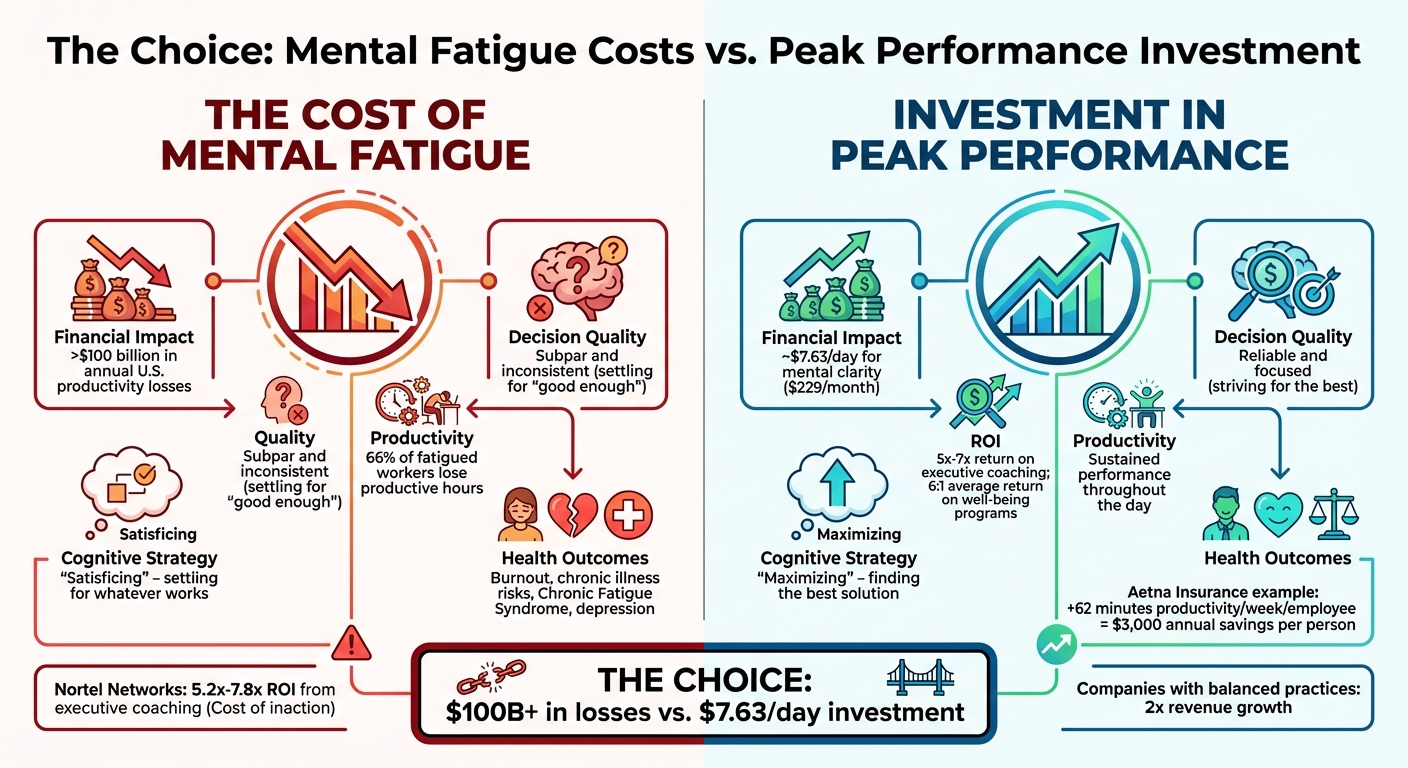
Mental Fatigue Costs vs Peak Performance Investment ROI Comparison
Cost of Mental Fatigue: Short-Term and Long-Term
Mental fatigue doesn’t just slow you down - it hits hard where it hurts most: productivity and decision-making. Short term, 66% of fatigued workers report losing productive hours compared to just 26% of their well-rested counterparts. This isn’t just about working slower; it’s about making poorer choices. When your brain is drained, it switches from "maximizing" (finding the best solution) to "satisficing" (settling for whatever works). That shift can lead to costly mistakes, especially in high-stakes decisions.
Long-term, the numbers are even bleaker. Fatigue-related losses cost U.S. employers over $100 billion annually. Prolonged mental fatigue can snowball into burnout, strained relationships, and serious health issues like Chronic Fatigue Syndrome or depression. It’s a vicious cycle: the more you push through without addressing fatigue, the less you get back for your effort.
Investment in Peak Performance: Returns and Benefits
Shifting focus to peak performance changes the game. By increasing perceived rewards - through clear goals, better incentives, or supportive tools - you can counteract fatigue and reactivate your brain’s ability to function at its best. This means sharper focus, better decision-making, and more consistent output, even when under pressure.
The payoff is tangible. Professionals who use structured energy-management strategies report steady productivity and high-quality decisions throughout the day. Take Founders Fuel’s approach: targeted nootropics and botanicals designed to support mental clarity. For $229/month (12 bottles, 24 servings), that’s about $7.63 per day to keep your mind sharp - far less than what fatigue costs in lost time and bad decisions.
Side-by-Side Comparison: Costs vs. Investments
Here’s how the numbers stack up:
| Feature | Cost of Mental Fatigue | Investment in Peak Performance |
|---|---|---|
| Financial Impact | >$100B annual productivity losses (U.S.) | ~$7.63/day for mental clarity |
| Decision Quality | Subpar, inconsistent | Reliable, focused |
| Productivity | 66% of fatigued workers lose time | Sustained performance |
| Cognitive Strategy | Settling for "good enough" | Striving for the best |
| Health Outcome | Burnout, chronic illness risks | Better engagement, improved well-being |
The takeaway? Mental fatigue isn’t just expensive - it’s a drain on your potential. Investing in peak performance isn’t just about avoiding losses; it’s about unlocking your ability to consistently deliver your best when it matters most.
Conclusion: Choosing Peak Performance for Long-Term Success
Key Takeaways
Mental fatigue is costing U.S. employers a staggering $136 billion annually, impacting over 70 million Americans. For entrepreneurs, the stakes are even higher - nearly half report experiencing burnout, and over half say stress hampers their ability to focus at work. Even more concerning is the hidden toll of presenteeism, where working while unwell often leads to greater losses than taking time off. The fallout? Slower decisions, weakened collaboration, and extended recovery times.
But there’s a better way forward. Investing in strategies for peak performance is not only feasible but cost-effective. For as little as $7.63 a day, you can protect your mental clarity - far cheaper than the price of fatigue-related setbacks. Entrepreneurs who embrace structured workflows, offload non-essential tasks, and incorporate natural cognitive aids often report steadier productivity and sharper decision-making. Mindfulness practices can also help recharge energy lost to stress and reduce unproductive emotional cycles, enabling you to stay motivated without hitting burnout.
These actionable insights offer a clear roadmap for enhancing focus and performance.
Next Steps
The evidence is clear: small, strategic changes can combat the heavy toll of mental fatigue. Begin by creating structured workflows and setting firm time limits to minimize decision fatigue. Offload tasks that sap your energy but don’t drive business growth. To further support mental clarity, consider Founders Fuel’s blend of Kava, Whole Leaf Kratom, Lion’s Mane, and L-theanine for a natural boost.
The choice is yours: let fatigue derail your potential or commit to sustaining peak performance. Those who understand that mental clarity is the backbone of every decision and innovation will be the ones who thrive in the long run.
FAQs
How do I know if I’m mentally fatigued or just stressed?
Mental fatigue shows up as constant tiredness, trouble concentrating, and a foggy mind, especially after extended mental effort. Stress, however, often brings irritability, anxiety, or physical signs like a rapid heartbeat, usually linked to specific triggers. If you’re feeling wiped out even after resting, mental fatigue might be the culprit. Incorporating peak performance habits along with botanicals like kava or kratom could support managing both challenges. (These statements have not been evaluated by the Food and Drug Administration. This product is not intended to diagnose, treat, cure, or prevent any disease.)
What’s the quickest daily habit to reduce decision fatigue?
The fastest way to cut down on decision fatigue is by using natural options like L-Theanine or Lion's Mane, as well as adaptogens like Kava. These can help maintain focus and calmness, offering steady clarity without the dreaded energy crashes, so you can keep your mind sharp and steady all day long.
Are Kava, Kratom, Lion’s Mane, and L-theanine safe to combine?
Combining Kava, Kratom, Lion’s Mane, and L-theanine can be done safely if used responsibly and in moderation. However, it’s crucial to consider potential risks. Excessive doses or prolonged use might lead to issues like liver strain or unwanted interactions. Among these, L-theanine is widely regarded as safe, particularly for promoting relaxation and focus. Still, it’s essential to consult a healthcare professional before using these substances together, especially if you have preexisting health conditions or are on medication.
