

How to Achieve Limitless-Level Focus
Jan 8th 2026
Want focus that feels superhuman? Skip quick fixes. Real focus comes from balancing your brain’s chemistry and setting up habits that work with your natural rhythms. Here’s how:
- Use natural nootropics: Options like Kava (stress), Lion’s Mane (memory), L-Theanine (calm focus), and Whole Leaf Kratom (energy) can fine-tune your brain without the crash of caffeine.
- Biohack your brain: Try 90-minute work cycles, cold exposure for dopamine boosts, and controlled breathing to sharpen your mental edge.
- Prioritize recovery: Sleep like it’s your job. Stick to a schedule, avoid screens before bed, and start your day with sunlight.
- Track progress: Use simple tools like journals or wearables to measure your focus and adjust your routine.
It’s not about working harder - it’s about working smarter. Combine these strategies, and you’ll see a real boost in focus and productivity. Let’s break it down.
Focus Toolkit: Tools to Improve Your Focus & Concentration
sbb-itb-02d64da
Step 1: Using Natural Nootropics for Mental Clarity
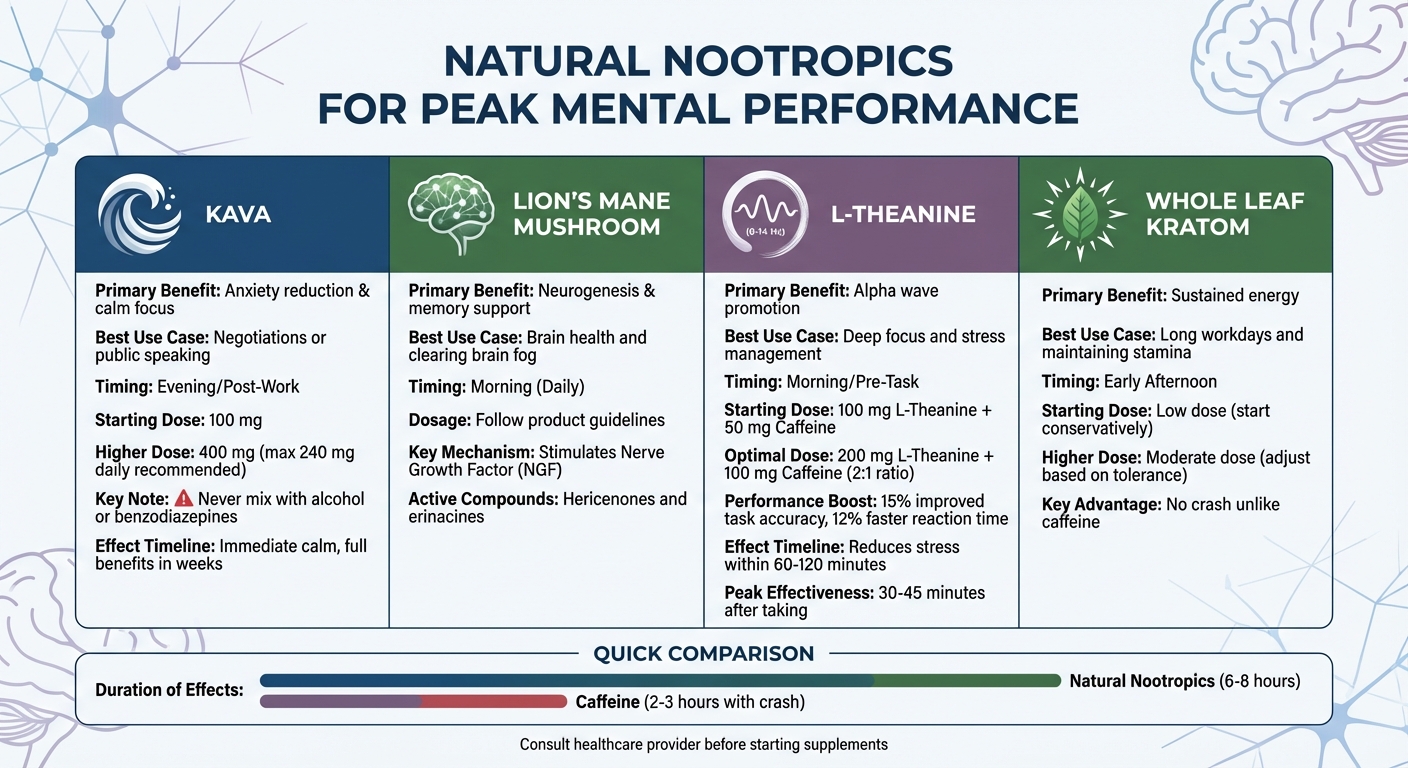
Natural Nootropics Guide: Benefits, Timing, and Dosage for Peak Focus
Natural nootropics can help sharpen memory and improve learning by supporting brain metabolism, enhancing blood flow, and balancing neurotransmitters. Unlike synthetic stimulants that often cause energy spikes followed by crashes, these plant-based options offer steady, reliable mental performance.
Each nootropic targets specific challenges that high-performing entrepreneurs often face. Kava helps ease performance-related anxiety, Lion's Mane aids memory and reduces brain fog, L-Theanine promotes calm focus, and Whole Leaf Kratom provides energy to sustain long workdays.
Kava for Calm Focus
Kava (Piper methysticum) has been a part of South Pacific traditions for centuries, known for promoting relaxation without causing drowsiness. It’s particularly effective in reducing anxiety during high-pressure situations. While some users feel calmer almost immediately, the full benefits for anxiety relief typically develop over a few weeks of consistent use. To avoid potential liver-related risks, daily intake should stay below 240 mg. Never mix Kava with alcohol or benzodiazepines, as this combination can lead to excessive sedation and increase the risk of liver damage.
Whole Leaf Kratom for Sustained Energy
Whole Leaf Kratom offers a steady energy boost, making it ideal for tackling long workdays. Unlike caffeine, which often leads to energy highs followed by crashes, Kratom provides a gradual and consistent release of energy. This makes it a go-to option for entrepreneurs needing to maintain focus and stamina during extended work sessions.
Lion's Mane Mushroom for Cognitive Clarity
Lion's Mane Mushroom is a standout nootropic that stimulates Nerve Growth Factor (NGF), a protein essential for maintaining and repairing nerve cells. By promoting neurogenesis, it helps the brain form new connections, which can enhance memory and improve clarity - valuable for navigating complex decisions and quick problem-solving.
"Lion's Mane promotes neuroplasticity by stimulating Nerve Growth Factor (NGF), which enhances the brain's ability to form new connections." - Mind Lab Pro
The mushroom’s active compounds, hericenones and erinacines, can cross the blood-brain barrier to deliver these cognitive benefits. Daily use is recommended for building long-term cognitive resilience.
L-Theanine for Stress Reduction
L-Theanine works by increasing alpha brain waves (8–14 Hz), fostering a state of calm alertness. It can reduce stress and cortisol levels within 60 to 120 minutes.
"L-Theanine encourages a relaxed, anxiety-free state by modulating alpha brainwaves, creating a mental state similar to meditation." - Mind Lab Pro
For the best results, combine L-Theanine with caffeine in a 2:1 ratio (e.g., 200 mg of L-Theanine with 100 mg of caffeine). This pairing can improve task accuracy by 15% and reaction time by 12%, while also reducing caffeine-induced jitters. Taking this combination about 30–45 minutes before a deep-work session or a high-pressure meeting ensures it reaches peak effectiveness right when you need it.
| Nootropic | Primary Cognitive Benefit | Entrepreneurial Use Case |
|---|---|---|
| Kava | Anxiety reduction & calm focus | Negotiations or public speaking |
| Lion's Mane | Neurogenesis & memory support | Brain health and clearing brain fog |
| L-Theanine | Alpha wave promotion | Deep focus and stress management |
| Whole Leaf Kratom | Sustained energy | Long workdays and maintaining stamina |
With these natural nootropics in your toolkit, you can set up a daily supplement routine to maximize their benefits and maintain mental clarity throughout your day.
Step 2: Creating a Daily Supplement Schedule
To get the most out of your supplements, align their timing with your body’s natural rhythms: mornings for energy, afternoons to combat slumps, and evenings for winding down. This approach pairs well with biohacking techniques aimed at sharpening focus and productivity.
Timing and Dosage for Best Results
Morning: Kickstart your day. Morning is the perfect time to take advantage of your body’s natural cortisol peak. Start with Lion's Mane to support brain health and promote neurogenesis. Pair this with a 2:1 mix of L-Theanine and caffeine (e.g., 200 mg L-Theanine and 100 mg caffeine) for smooth, sustained energy that kicks in within a few hours.
Afternoon: Beat the midday crash. If you’re looking for a boost during the afternoon dip, Whole Leaf Kratom can help sustain energy and focus. Beginners should start with a low dose to gauge tolerance before gradually increasing.
Evening: Time to unwind. Kava works best in the evening, helping you relax after a long day. Start with a small dose and adjust as needed to find your sweet spot for relaxation.
| Supplement | Best Timing | Starting Dose | Higher Dose |
|---|---|---|---|
| Lion's Mane | Morning (Daily) | Follow product guidelines | Follow product guidelines |
| L-Theanine + Caffeine | Morning/Pre-Task | 100 mg L-Theanine + 50 mg Caffeine | 200 mg L-Theanine + 100 mg Caffeine |
| Whole Leaf Kratom | Early Afternoon | Start with a low dose | Adjust to a moderate dose |
| Kava | Evening/Post-Work | 100 mg | 400 mg |
Hydration and Supplement Combinations
Staying hydrated is non-negotiable. Even mild dehydration can mess with your memory, focus, and mood. Start your day with a glass of water to jumpstart neurotransmission and help your body absorb nutrients. Throughout the day, sip on water or herbal tea alongside your supplements to keep energy levels steady.
Fat-soluble supplements need a boost. Pair fat-soluble nootropics with meals that include healthy fats to maximize absorption.
Stacking for synergy. Combining certain supplements can amplify their effects. For example, pairing Citicoline with DHA and B vitamins can deliver more pronounced cognitive benefits than taking them individually. If you’re trying a new stack, introduce one ingredient at a time and monitor how you feel for at least a week before making changes.
Simplify with Founders Fuel
Managing multiple supplements can be a hassle. Founders Fuel makes it easy with their 2 oz pre-measured bottles, combining Kava, Whole Leaf Kratom, Lion's Mane, and L-Theanine into a single, ready-to-go serving. No measuring, mixing, or cleanup - just grab a bottle and take it when you need it. Stash one in your bag, desk, or car for ultimate convenience.
For those who want consistency, the Founders Circle subscription ($229/month for 12 bottles, 24 servings) ensures you’re always stocked. It’s a practical solution for entrepreneurs who want peak mental performance without the headache of DIY supplement stacks. Plus, every bottle is packed with high-quality, rigorously tested botanicals, so you can focus on what matters most.
Step 3: Adding Biohacking Techniques to Improve Focus
Supplements can do wonders, but to really unlock their potential, pairing them with deliberate practices that fine-tune your brain's natural systems is key. These biohacking techniques don’t require fancy equipment and can be put into action immediately to amplify the cognitive benefits of your daily supplement lineup.
Meditation and Breathwork
Your breath is a powerful tool for shifting your mental state in seconds. Controlled breathing acts as a bridge between the subconscious and conscious mind, helping you sharpen focus or calm down on demand.
"Deliberate respiration (breathing) represents a unique and powerful bridge between the subconscious and conscious mind."
– Andrew Huberman, Ph.D., Huberman Lab
For a quick jolt of alertness, try cyclic hyperventilation: deeply inhale through your nose, exhale fully through your mouth, and repeat 25 times. Then, hold your breath on an empty lung for 15–30 seconds. This triggers an adrenaline rush that sharpens focus almost instantly. (Skip this near water or while driving - safety first.)
Feeling stressed? The physiological sigh is your go-to. Take a deep inhale, add a quick "top-up" inhale, then exhale slowly. Just 5 minutes of this daily can lower stress and improve your mood.
For deep work sessions, box breathing is a game-changer. Follow a 4-4-4-4 rhythm: inhale for 4 seconds, hold for 4 seconds, exhale for 4 seconds, and hold again for 4 seconds. This technique helps regulate your breathing and keeps you centered. Even short mindfulness practices - like 8 minutes of mindful breathing or a 10-minute guided session - can reduce distractions and improve attention, especially for those prone to anxiety.
When you’re not actively practicing these techniques, prioritize nasal breathing. It increases oxygen delivery and nitric oxide production, promoting a calm and focused state. Most people over-breathe, taking 15–18 breaths per minute instead of the healthier 12 breaths. This can lower CO₂ levels and contribute to feelings of anxiety.
These mindful breathing practices set the stage beautifully for the next layer of focus-boosting biohacks.
Cold Exposure for Dopamine Boosts
Cold exposure is another powerhouse technique for recalibrating your neurochemistry. Cold showers or ice baths trigger a significant increase in dopamine, the neurotransmitter responsible for improving mood, focus, and motivation.
"Dopamine is a powerful molecule capable of elevating mood, enhancing focus, attention, goal-directed behavior, etc. Even short bouts of cold exposure can cause a lasting increase in dopamine and sustained elevation of mood, energy, and focus."
– Andrew Huberman, Ph.D., Stanford School of Medicine
The science-backed sweet spot? About 11 minutes of cold exposure weekly, split into 2–4 sessions lasting 1–5 minutes each. For maximum effect, aim for water around 60°F for longer periods or as low as 40°F for shorter bursts.
Cold exposure also boosts mental resilience. When you push through the discomfort, you’re training your brain's prefrontal cortex to exert control over stress, building what many call grit or resilience.
"By forcing yourself to embrace the stress of cold exposure as a meaningful self-directed challenge... you exert what is called 'top-down control' over deeper brain centers that regulate reflexive states."
– Andrew Huberman, Ph.D., Stanford School of Medicine
Choose a temperature that’s uncomfortable but safe. When you feel the urge to quit, treat it as a mental challenge to overcome. Let your body reheat naturally afterward instead of jumping into a hot shower, and try to do this early in the day to enjoy a sustained boost in alertness.
90-Minute Focus Cycles
Your brain operates in natural 90-minute cycles, known as ultradian rhythms. Ignoring these rhythms can drain key neurotransmitters like acetylcholine and dopamine, leading to reduced cognitive performance.
A 90-minute focus cycle has three parts: a 5–10 minute warm-up, 70–80 minutes of deep work, and a 10–30 minute recovery break.
To kickstart focus during your warm-up, try visual gaze training (staring at a single point for 30–60 seconds) or listen to 40 Hz binaural beats for 5 minutes.
The recovery break is just as vital. Use it for deep rest (NSDR), a short walk without your phone, or even gazing at distant objects to reset your neurochemicals. Avoid screens during this time to give your dopamine system a proper reset. If you’re dragging between cycles, a quick 10-minute walk or climbing stairs can help recharge your brain.
Timing your focus cycles to your metabolic state can also make a difference. For example, work sessions in the morning while fasted can heighten focus by reducing parasympathetic activity, while sessions a few hours after lunch - when glucose levels are higher - can fuel intense mental effort. Environmental cues like bright lighting or a dedicated playlist can help signal your brain that it’s time to focus.
Step 4: Recovery Strategies for Long-Term Focus
Your brain is a powerhouse, burning through about 20% of your body’s daily energy. But without proper recovery, all that mental effort can quickly lead to burnout. By prioritizing recovery, you can protect your mental stamina and keep your cognitive performance sharp. Here’s how to stay on top of your game.
Sleep Hygiene Practices
Sleep is your brain’s reset button - it clears out waste and locks in what you’ve learned. The key isn’t just how long you sleep but sticking to a consistent schedule. Research suggests that regular sleep and wake times are more closely tied to health and longevity than simply racking up hours of sleep.
"We are creatures of habit and finding ways to internalize a routine is the path to success."
– David Rosen, MD, Sleep Medicine Physician
Set up your bedroom for success: keep it cool (around 65°F), pitch dark (think blackout curtains or an eye mask), and quiet (white noise or earplugs can help). Unplug from screens 30–60 minutes before bed - blue light can mess with melatonin production. If you’re tossing and turning for more than 20 minutes, get up and do something calming in dim light. This helps reinforce that your bed is for sleep, not frustration.
Start your day with sunlight. A solid 30–40 minutes of natural light early in the morning can anchor your circadian rhythm and improve nighttime sleep quality. And don’t underestimate the impact of caffeine - cut it off by 2:00 PM, as its effects can linger for up to 10 hours. If racing thoughts keep you awake, try counting backwards from 1,000 in sevens or paradoxically challenge yourself to stay awake - sometimes that’s all it takes to drift off.
Pairing good sleep habits with stress management techniques can further enhance recovery.
Stress Management and Relaxation
Chronic stress isn’t just a mood killer - it floods your brain with cortisol, leading to brain fog and slower thinking. To counteract this, engage your parasympathetic nervous system with techniques like cyclic sighing: take a deep inhale, a short second inhale, and then a long exhale. It’s a quick way to calm your system.
"I want people to know they are in control of their health... Small daily habits compound, in either direction."
– Dr. Ryan Williamson, Neurologist
Nature is another powerful stress antidote. Just 20 minutes outside can significantly lower cortisol, and even a 40-second glance at greenery can help you refocus during demanding tasks. If stepping outside isn’t an option, position your workspace near a window or use high-quality nature images as your screensaver. Structured breaks, like those in the Pomodoro technique, can also keep fatigue at bay while boosting productivity.
Consulting Healthcare Professionals
Thinking about trying nootropics? Talk to a healthcare provider first, especially if you’re new to supplements or dealing with existing health conditions. This is especially important with options like Kava or Ashwagandha, which come with potential risks. For example, Ashwagandha can increase thyroid hormone production, which might worsen hyperthyroidism or lead to thyrotoxicosis.
"There is a lack of evidence to support many nootropics as both beneficial and safe. It's important to discuss adding any supplements to your diet with your trusted healthcare professional."
– Helen West, RD, Healthline
Pregnant or breastfeeding? Proceed with extra caution. Kava use during pregnancy has been linked to a 2.5 times higher risk of low birth weight. A healthcare provider can help you navigate potential interactions, adjust dosages, and address any nutrient deficiencies that might be affecting your cognitive health. When trying new supplements, start with the smallest possible dose and stick to brands that offer third-party testing and standardized extracts for reliable quality.
Step 5: Tracking and Adjusting Your Focus Progress
If you want to improve, you’ve got to measure. Keeping tabs on your cognitive performance gives you clear data about what’s working and what needs a tweak.
Tracking Cognitive Performance
Start simple. Use a 0–10 scale to rate your stress, energy, and motivation levels before and after your focus routines. Log these daily in a journal or notes app - don’t overcomplicate it. For something more objective, try a 10-minute reading recall test: read a dense article, then jot down everything you remember. Your goal? A 10–15% improvement within two weeks of trying your new strategies.
Tech can help too. Wearable devices like the Oura Ring monitor Heart Rate Variability (HRV), sleep quality, and stress - key indicators of cognitive health. Another low-tech option: count your breaths for one minute every morning. A gradual decrease over time suggests better stress resilience. Track your productivity for a week to find your natural "energy peaks" - those golden hours when your brain is firing on all cylinders. During 90-minute focus blocks, keep a "distraction capture" pad handy to jot down off-topic thoughts. This will show how often your mind wanders and pinpoint what’s stealing your attention.
"Your health is the same - small daily habits compound, in either direction."
– Dr. Ryan Williamson, Neurologist
These insights don’t just help you stay sharp - they also reveal patterns you can use to fine-tune your approach, including your supplement routine.
Adjusting Dosage and Routines
Once you’ve tracked your progress, adjust your supplements and routines accordingly. Nootropics usually take 2–3 weeks of consistent use to deliver stable results. Dose matters - a common mistake is starting too low to see any real effect. Begin with the lowest effective dose and only increase if needed, as long as there are no side effects.
Introduce one supplement at a time, giving it at least a week to gauge its impact. This makes it easier to isolate what’s working - or what’s not. If you notice issues like insomnia, irritability, nausea, or headaches, adjust or stop the supplement altogether. For stimulants like caffeine, stick to a "5 days on, 2 days off" schedule each week to avoid building tolerance. If you’re feeling drained with fatigue levels hitting 7/10, cut your focus intervals to 20 minutes, followed by a quick 5-minute break.
Fine-tuning isn’t just about making changes - it’s about making the right changes for consistent, sustainable progress.
Conclusion
Achieving laser-sharp focus starts with nailing the basics: get enough sleep, stay hydrated, and fuel your body with proper nutrition. Without these essentials, even the most advanced nootropics or biohacks can fall flat. As Stephen M. Walker II wisely says:
"Jet fuel only really works when the jet is built properly."
Once the groundwork is solid, you can turn to natural nootropics like Kava, Whole Leaf Kratom, Lion's Mane, and L-Theanine. These options help balance neurotransmitters and provide 6–8 hours of steady mental clarity, a stark contrast to the short-lived 2–3 hour buzz (and crash) from caffeine. Combine these with practical biohacks - like 90-minute focus cycles, 5 minutes of cyclic sighing to lower cortisol, or a quick 40-second gaze at greenery to refresh your attention span - and you’ll have a system that works seamlessly with your body’s natural rhythms.
Good sleep plays a critical role too. It clears out metabolic waste and, when paired with stress management, keeps your nervous system out of "survival mode". Tracking your progress with simple tools like HRV monitors or self-assessment scales can help you refine your nootropic and biohacking strategies. Stick to these routines, and you could see a 10–15% boost in cognitive performance within 2–4 weeks.
Minimizing recovery time after distractions is another game-changer. Regaining focus after an interruption typically takes about 23 minutes, so aligning challenging tasks with your natural energy peaks can give you a serious edge. And with the average person switching between apps nearly 1,200 times a day, cutting through that digital noise can free up hours of productive time. Focus isn’t just a lucky trait - it’s a skill you can train. These strategies give you the tools to master it.
FAQs
What are the risks and side effects of using natural nootropics like Kava and Whole Leaf Kratom?
Natural nootropics like Kava and Whole Leaf Kratom can offer benefits like promoting focus and relaxation, but they’re not without risks. Kava is often praised for its calming effects, yet overuse or prolonged consumption may harm the liver. Other potential side effects include drowsiness, dizziness, stomach upset, or even skin issues. Mixing Kava with alcohol or sedatives can amplify these risks and should be strictly avoided.
Whole Leaf Kratom, meanwhile, has its own set of concerns. It may cause nausea, constipation, and, in some cases, an increased heart rate or elevated blood pressure. Regular or high doses can lead to dependence and withdrawal symptoms. Additionally, Kratom may interact dangerously with medications like antidepressants or opioids, making it essential to consult a healthcare provider before use.
To minimize risks, stick to recommended dosages, pay attention to how your body reacts, and seek professional medical advice if you have any health conditions or take other medications.
What are the best ways to track and measure improvements in focus and productivity?
To keep tabs on your focus and productivity, start by establishing a baseline. Try using a timer - something like the Pomodoro technique works well - and focus on a single task. Track how long you can stay deeply engaged before your mind starts to wander. This gives you a solid starting point to measure progress.
Your sleep is just as important. Consider using a sleep tracker or a wearable device to monitor how well you’re resting each night. Aim for 7–9 hours of quality sleep, as it directly affects your focus and performance during the day.
Lastly, keep track of your daily accomplishments. Log the number of key tasks or goals you complete. By combining this with your focus and sleep data, you can start spotting patterns and make tweaks to your routine. A weekly review of this data can help you fine-tune your habits and maintain top performance levels.
What are some easy biohacks to improve focus without using supplements?
Improving focus doesn’t have to involve supplements - just a few straightforward habits can make a big difference:
- Get enough quality sleep: Make 7–9 hours of uninterrupted sleep a nightly goal. Stick to a steady bedtime routine, like avoiding screens for at least 30 minutes before bed. This helps recharge your mind and reduces mental fog.
- Work in focused bursts: Set aside 45–60 minutes for one task at a time, free from interruptions. Silence notifications and steer clear of multitasking to avoid the mental drain of constant task-switching.
- Move regularly: Take a quick break every 30–60 minutes to stand, stretch, or do light physical activity. Even small movements boost blood flow to your brain, keeping you alert and focused.
These simple adjustments can naturally sharpen your focus and mental clarity - no supplements required.
